Reader → Tag Backscatter
UHF RAIN RFID · ISO 18000-63 · GS1 EPC Gen2

Passive RFID Technology

Battery-free, high-speed wireless identification that lets enterprises automatically track every asset, container, and item — reading hundreds of tags simultaneously, without line-of-sight, at distances up to 12 meters. The most proven, scalable, and cost-effective auto-ID technology in enterprise operations.

1,000+
Tags / Second
12m
Read Range
99.9%
Read Accuracy
20+ yr
Tag Lifespan
Technology Overview

What is Passive RFID?

Passive RFID (RAIN RFID) operates in the UHF band (860–960 MHz). Tags harvest energy from the reader's radio field to respond with a unique identifier — enabling massive deployments with no batteries, no charging, and no manual scanning. One portal reader at a dock door processes an entire pallet in under 3 seconds. For a full comparison against BLE, UWB and other technologies, see our RTLS technologies comparison guide.

Passive Tag
Battery-free label or hard tag. Stores EPC + TID + User Memory
UHF 860–960 MHz
RF Energy
Backscatter
RFID Antenna
Fixed portals, dock doors, conveyor tunnels, handheld readers
Linear / Circular
Coax / PoE
RFID Reader
Fixed or handheld. Reads 1,000+ tags/sec via ISO 18000-63
GS1 EPC Gen2
TCP/IP · REST
SmartX HUB®
Real-time dashboards, alerts, ERP/WMS/SAP integration
Platform
01
Energy Harvesting — No Battery
The reader emits a continuous RF field. When a tag enters this field, its antenna harvests enough energy to power the chip and transmit its EPC back — no internal power source needed. Industrial tags survive 10–20+ years with zero maintenance.
02
Backscatter Communication
Tags respond by modulating and reflecting the reader's RF signal. The reader decodes this reflected signal to extract the tag's EPC (Electronic Product Code), TID (unique chip serial), and any user-defined memory such as serial numbers or batch codes.
03
Anti-Collision — Mass Reads
GS1 EPC Gen2 / ISO 18000-63 uses a Slotted ALOHA singulation algorithm to manage hundreds of simultaneous tag responses — enabling readers to identify 1,000+ unique tags per second. A full pallet is verified in under 3 seconds at a dock door portal.
04
Tag Memory — EPC, TID, User
Each tag carries a factory-locked TID (unique chip serial), a configurable EPC (GS1 SGTIN, asset number, or custom), and optional User Memory for storing serial numbers, batch codes, calibration dates, or custody chain directly on the physical tag.
05
Impinj Gen2X — Advanced Security
Gen2X introduces Protected Mode (tags invisible to unauthorized readers), Endpoint IC Verification (anti-counterfeit authentication), and FastID (TID+EPC combined in a single read cycle) — backward-compatible with all existing Gen2 infrastructure.
06
SmartX HUB Integration
Read events stream via LLRP, REST API, or MQTT through Node-RED middleware. SmartX HUB maps each EPC to an asset or item record, executes business rules (GRN creation, cycle count reconciliation, CMMS work orders), and syncs bidirectionally with SAP, D365 F&O, and WMS systems.
Key Advantages

Why Passive RFID Leads in Asset Identification

The most proven, scalable, and cost-effective automatic identification technology in enterprise operations — delivering speed, accuracy, and ROI that barcode and manual processes cannot match at scale.

Zero Batteries, Zero Maintenance
Passive tags require no batteries and no maintenance. Industrial hard tags last 10–20+ years and survive temperatures from −40°C to +250°C, chemical exposure, pressure washing, and mechanical shock — ideal for manufacturing, oil & gas, and outdoor logistics environments.
20+ Year Tag Lifespan
Mass Read Speed
A single fixed reader processes 1,000+ unique tags per second. A dock door portal verifies an entire pallet load automatically as it passes through — in under 3 seconds. This is simply not achievable with barcodes or manual counting at any industrial scale.
1,000+ Tags per Second
Lowest Tag Cost in IoT
UHF passive inlays start from around $0.05–$0.10 at volume. Industrial hard tags range from roughly $0.80–$5.00 for on-metal and high-temperature applications. This makes item-level tagging economically viable for every asset class — from small spare parts to full pallets and RTI containers.
From ~$0.05 per Tag
No Line-of-Sight Required
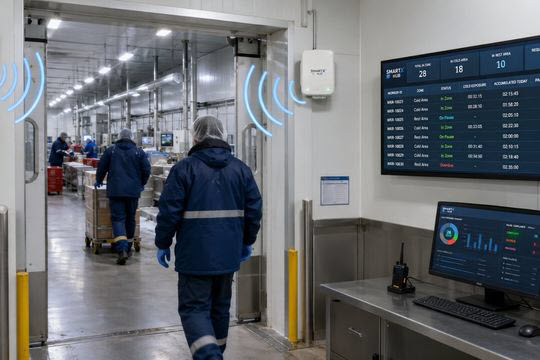
Unlike barcodes, RFID reads through cardboard boxes, plastic crates, and fabric. Tags on items inside a sealed box are identified as the box passes a portal — enabling fully automated receiving, shipping verification, and inventory counts with zero manual scanning effort.
Read Through Packaging
Flexible Read Range
Reads from a few centimeters to up to 12 meters depending on antenna gain and reader power. This single technology enables contact-range desktop reads (smart cabinet, tool crib), dock door portal automation, and wide-area warehouse inventory counts from ceiling-mounted readers.
Up to 12 Meters Range
Open Global Standard
GS1 EPC Gen2 / ISO 18000-63 is the global interoperability standard deployed by thousands of companies across retail, logistics, manufacturing, and oil & gas. Any certified tag works with any certified reader — no vendor lock-in. Fully compatible with GS1 EPCIS 2.0 supply chain traceability.
ISO 18000-63 · GS1 EPC Gen2
Core Applications

Three Pillars of SmartX Passive RFID

SmartX HUB deploys passive RFID across three high-impact enterprise domains — each with purpose-built tag selections, reader configurations, and platform workflows drawn from real deployments across 350+ global installations.

Asset Inventory & Physical Audit

Replace manual barcode scanning and spreadsheet-based asset registers with automated, real-time RFID visibility. Tag every asset once and gain continuous, accurate location, status, and audit data — without manual intervention during day-to-day operations. Automated cycle counts replace periodic physical inventories that previously took days per site.

  • Automated physical inventory — read thousands of assets in minutes, not days
  • Asset receipt against Purchase Order with automated validation and asset numbering
  • Automated cycle count by asset list — continuous RFID reading via fixed readers
  • Portal readers detect every asset entering or leaving rooms, zones, and buildings
  • Check-In / Check-Out with instant custody transfer and digital handover records
  • Lost item location via RFID Geiger (sound collector) using handheld scanner
  • Permits and certificate management — automated expiry warnings per asset
  • Full audit trail for ISO 55001, SAP PM, and D365 F&O asset lifecycle compliance
Agribusiness — 10,000+ Assets Across Multi-Site
A large agribusiness operation manages 10,000+ high-value assets across multiple facilities using SmartX HUB with QR codes and handheld readers. Physical audits that previously took weeks are now completed in hours, with 99%+ accuracy and full SAP integration.
Manufacturing — Fixed Asset Audit with RFID Portals
Industrial facilities tag machinery, production equipment, and calibrated instruments with on-metal hard tags. Ceiling-mounted RFID readers perform continuous cycle counts, replacing annual manual audits. Asset movement alerts fire instantly when equipment leaves authorized zones.
Construction — Equipment Fleet Tracking
Tag generators, compressors, scaffolding, and heavy tools on job sites. Portal readers at site gates capture every asset entering and leaving. SmartX HUB tracks utilization, flags idle assets, and auto-generates depreciation and rental cost reports per project.
Utilities — Substation Equipment Rounds
Tag transformers, switchgear, and metering equipment in substations. Field technicians with handheld RFID readers complete asset verification rounds far faster than barcode scanning. Results sync to SmartX HUB in real time, updating maintenance schedules automatically.

Logistics, Warehouse & Returnable Transport Items

Automate receiving docks, pallet loading, shipment verification, and the tracking of returnable containers throughout their full life cycle. RFID portal readers process entire pallet loads in seconds — eliminating manual scanning, reducing shipping errors by up to 90%, and providing end-to-end GS1 EPCIS traceability from supplier dock to customer delivery.

  • Dock door portals auto-confirm receiving against PO — no manual scanning required
  • Pallet loading via portals integrated with ERP for invoice preparation and dispatch
  • Shipment and dispatch counting with automated ERP verification and confirmation
  • Proof of Delivery — RFID read at destination confirms delivery and triggers ERP update
  • RFID Tunnel Control Center — full monitoring and power adjustment for conveyor lines
  • RTI traceability — pallets, crates, IBC containers, and gas cylinders — dispatch to return
  • Automated stock alerts and ERP-integrated replenishment orders at PAR level
  • Multi-site inventory dashboard with GS1 EPCIS 2.0 end-to-end traceability chain
Food Processing — Traceability & RTI Tracking
A major global food processor uses SmartX HUB to track trays, crates, and production batches through processing and cold storage. Portal reads at every stage build an automatic GS1 EPCIS chain. Uniform and PPE tracking across 50,000+ garments ensures NR-36 compliance.
Returnable Packaging — Crates, Pallets & IBCs
Tag plastic crates, euro pallets, and IBC containers with durable IP68 tags. SmartX HUB tracks every cycle — dispatch, customer use, return, and washing. Automatic loss alerts prevent container pool shrinkage and reduce replacement costs by up to 40%.
Distribution Center — Automated Dock Receiving
RFID tunnel readers on inbound conveyors scan every carton automatically. SmartX HUB matches reads against Purchase Orders, generates GRN records, and flags discrepancies before goods are put away. Receiving time reduced from hours to minutes per truck.
Aerospace — Parts Traceability
RFID tags on aircraft components and tooling containers provide full cradle-to-grave parts traceability. SmartX HUB verifies kitting completeness before assembly operations, eliminating foreign object debris risk and generating AS9100 audit records automatically at each production stage.

MRO Inventory & Tool Control

Transform maintenance, repair, and operations inventory from a cost center into a fully controlled, auditable process. RFID-enabled tool cribs, smart cabinets, and mobile readers eliminate tool loss, enforce calibration compliance, automate spare parts replenishment, and provide complete accountability for every tool and consumable — from issue to return.

  • RFID smart cabinets and tool cribs — real-time check-in/out with full user accountability
  • FOD prevention — verify tool kit 100% complete before and after every maintenance task
  • Calibration and permit tracking — automatic alerts when instruments approach expiry
  • Spare parts MRO inventory — RFID shelf readers trigger automatic reorder at PAR level
  • Tool authorization — block uncertified users from accessing safety-critical equipment
  • Complete maintenance history per tool — every read event logged with time, user, location
  • Mobile RFID handheld for field technicians — live sync to SmartX HUB CMMS
  • Automatic CMMS work order creation for tool maintenance and certification renewals
Oil & Gas — Offshore MRO & Tool Control
Critical tools and safety equipment on offshore platforms are tagged with high-temperature, ATEX-certified tags. SmartX HUB enforces tool kit completeness before confined space entry and blocked-valve operations. Certification expiry alerts prevent uncertified equipment use in ATEX zones.
RFID Smart Tool Crib — Manufacturing Plant
Miniature tags on every torque wrench, caliper, and gauge. RFID readers on locker doors log every withdrawal and return by user, time, and asset ID. Missing tools trigger immediate alerts to the shift supervisor. Shift reconciliation reports generated automatically.
MRO Spare Parts — PAR Level Replenishment
RFID readers on parts bin shelves monitor stock levels continuously. When a spare part is removed, SmartX HUB compares the count against PAR level and sends a replenishment request to SAP MM or D365 SCM automatically — reducing stockouts and emergency purchase orders.
Aerospace MRO — FOD Prevention
Every tool in aircraft maintenance kits is tagged with miniature on-metal tags. RFID readers verify 100% kit count before and after every maintenance task, helping eliminate FOD incidents. FAA and EASA compliance records generated automatically per maintenance operation.
Technology Comparison

Passive RFID vs. Other ID Technologies

Understand when passive RFID delivers the highest ROI — and how it compares to barcodes, active RFID, and other identification methods for enterprise asset and inventory deployments.

FeaturePassive RFIDBarcode / QRActive RFID / BLENFC
Read Speed1,000+ tags/sec1 at a time~100 tags/sec1 tap at a time
Read RangeUp to 12 mLine-of-sight <1mUp to 100 m0–5 cm only
Tag Cost~$0.05–$5.00Near zero$15–$50$0.10–$1.00
Battery RequiredNo — passiveNoYes — 1–5 yrsNo
Line-of-SightNot requiredAlways requiredNot requiredDirect contact
Read Through PackagingYes (non-metal)NoYesNo
Best FitBulk reads, portals, inventory, RTI, MROSimple ID, low volume, cost-criticalReal-time location, outdoor trackingSingle-item tap, phone authentication
Industry Applications

Deployed Across Every Vertical

SmartX HUB Passive RFID runs live across enterprise clients in these industries — each with purpose-built tag selections, reader configurations, and compliance frameworks proven in production environments.

Manufacturing
Automate WIP tracking through production lines, verify tool kits before operations, and manage calibrated instruments at item level. Portal readers on assembly lines confirm correct components are installed. On-metal tags survive welding sparks, paint booths, and autoclave environments.
WIP TrackingTool ControlISO 55001
Warehousing & Logistics
Automate dock receiving, pallet loading, and outbound shipment verification. Portal readers process full truck loads in seconds. Real-time inventory accuracy at 99.9%+ reduces carrying costs, stockouts, and shipping errors. Automated GRN creation eliminates manual data entry.
Dock AutomationGS1 EPCISWMS
Returnable Transport Items
Track plastic crates, euro pallets, IBC containers, and gas cylinders from dispatch through return and washing. Durable IP68 tags survive industrial washing, outdoor storage, and forklift handling. Automatic loss alerts prevent container pool shrinkage and unauthorized diversion.
RTI TrackingContainer PoolLoss Prevention
Oil & Gas
Tag drill pipes, BHA components, pressure vessels, and safety-critical valves with explosion-safe tags. RFID portals at pipe yards verify inventory counts without manual inspection. Calibration certificate status is confirmed automatically at point of use, generating API 21.1 audit records.
Pipe TrackingCalibrationAPI 21.1
Food & Agribusiness
Tag trays, crates, and production batches through processing and distribution. Portal reads build an automatic GS1 EPCIS traceability chain at every stage. Uniform and PPE tracking across thousands of garments ensures NR-36 compliance and laundry cycle control without manual counting.
Food TraceabilityUniform TrackingHACCP
Aerospace & Defense
Tag every tool, GSE component, and aircraft part with miniature on-metal tags. RFID readers at airside gates verify all items returned before departure. Impinj Gen2X Endpoint IC Verification helps prevent counterfeit parts entering the supply chain. Full AS9100 audit trail per operation.
FOD PreventionAS9100Anti-Counterfeit


Not sure if RFID is right for your use case? See how RFID compares to BLE, UWB, LoRaWAN, and GPS in our RTLS technologies comparison guide, or explore UWB for centimeter-level precision.

Frequently Asked Questions

Passive RFID Questions Answered

Passive RFID (RAIN RFID) uses battery-free tags that harvest energy from a reader's UHF radio field (860–960 MHz) to transmit a unique identifier back via backscatter. Because tags need no battery and no line-of-sight, a single reader can identify over 1,000 tags per second at ranges up to 12 meters—enabling automated inventory, receiving, and asset tracking.

Passive UHF RFID reads from a few centimeters up to about 12 meters, depending on antenna gain, reader power, tag type, and environment. Short range suits desktop and smart-cabinet applications, while longer range enables dock-door portals and ceiling-mounted warehouse inventory reads.

Passive RFID tags have no battery, cost as little as a few cents, last 10–20+ years, and read up to 12 meters—ideal for inventory, receiving, and asset ID. Active RFID (and BLE) tags contain a battery, cost $15–$50, and read up to 100 meters for real-time location tracking. Passive is best for identification and counting; active is best for continuous location.

UHF passive inlay labels start from around $0.05–$0.10 at volume. Rugged industrial hard tags for on-metal or high-temperature use typically range from about $0.80 to $5.00 each. This low cost makes item-level tagging economically viable across virtually every asset class.

Barcodes require line-of-sight and are scanned one at a time. RFID reads hundreds of tags at once, through packaging, without line-of-sight, at a distance. RFID also stores more data and can be updated. Barcodes remain cheaper per label, so many operations use both—barcodes for low-volume ID and RFID for bulk automation.

Yes. Passive UHF RFID follows the GS1 EPC Gen2 / ISO 18000-63 global standard, so any certified tag works with any certified reader—no vendor lock-in. It is fully compatible with GS1 EPCIS 2.0 for end-to-end supply chain traceability. SmartX HUB is vendor-agnostic and works across leading RFID hardware brands.

Not sure if RFID is right for your use case? See how RFID compares to BLE, UWB, LoRaWAN, and GPS in our RTLS technologies comparison guide.

SOFTWARE PLATFORM

CLOUD-HOSTED SAFETY MONITORING, CONFIGURATION AND DATA ANALYTICS SOFTWARE

Many healthcare organizations want all the components of RTLS technology “under one roof”; that’s why SmartX HUB offers Best in  hardware, software, and services. The SmartX HUB is a cloud-based platform, the centralized hub for access to our comprehensive RTLS solution applications and system management tools. The unified user interface offers single sign-on capabilities and maintains a consistent look and feel across all applications, ensuring seamless navigation and optimal efficiency.

Book Appointment Online - Need Immediate Confirmation? Call Us at 407-450-9719

Explore our blog for insightful articles, personal reflections and ideas that inspire action on the topics you care about.

error: Content is protected !!