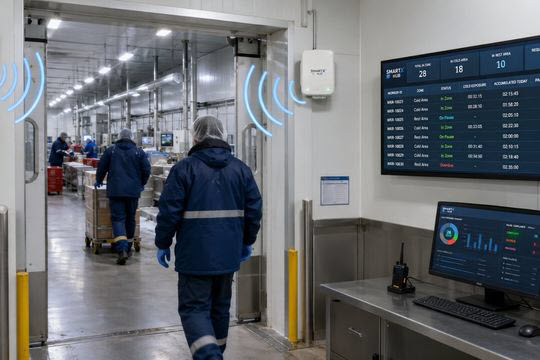
RFID Inventory Management: Count in Minutes, Not Days
RFID inventory management replaces slow, labor-heavy manual stock counts that are wrong more often than anyone admits. It reads hundreds of items at once without line-of-sight — turning a multi-day count into a task that takes minutes, with accuracy your planning systems can finally trust.
What Is RFID Inventory Management?
RFID inventory management uses radio-frequency tags on items, cases, or pallets to count and locate stock automatically — without line-of-sight scanning. A single reader captures hundreds of tags per second, so a full stock count that once took days of manual barcode scanning takes minutes, with far higher accuracy and a live view of what's on hand.
In most warehouses, inventory accuracy is quietly broken. Counts are done a few times a year, by hand, one barcode at a time — a process so slow and tedious that it's often rushed, sampled, or skipped. Between counts, the numbers drift: items get miscounted, misplaced, or shipped without being logged, and the gap between what the system says and what's actually on the shelf grows.
RFID closes that gap. Because RFID tags don't need line-of-sight and can be read in bulk, counting becomes fast enough to do often — weekly, daily, or continuously. A worker walks an aisle with a handheld and reads every tagged item on every shelf in seconds; fixed readers can count automatically as goods move. The result is inventory data that stays accurate, not a snapshot that's stale the moment it's taken. It's one of the highest-volume processes in the broader set of RFID and RTLS logistics processes.
RFID vs. Barcode Inventory
Barcodes aren't going away — they're cheap and universal. But for inventory at scale, RFID changes what's possible. Here's how they compare on what matters.
| Capability | Barcode | RFID |
|---|---|---|
| Line of sight | Required — scan each label directly | Not needed — reads through boxes & stacks |
| Read speed | One item at a time | Hundreds of items per second |
| Full count time | Hours to days | Minutes |
| Labor | High — manual scan per item | Low — sweep an area or read automatically |
| Human error | Miskeyed, missed, or double-scanned | Minimal — automated capture |
| Tag cost | Effectively free (printed) | Low, and falling — cents per tag |
| Best for | Low volume, single-item lookups | High volume, fast full counts, bulk reads |
From Sweep to Reconciled Count
RFID inventory follows a simple, repeatable loop — fast enough to run as often as the operation needs, from a monthly full count to continuous cycle counting.
What RFID Inventory Delivers
Faster counts are just the start. Accurate, frequent inventory data changes what the whole operation can do.
What Powers RFID Inventory
Most warehouse inventory runs on passive UHF RFID — tags with no battery, powered by the reader's signal, cheap enough to put on individual items and cases. They're read by handheld readers for aisle sweeps and cycle counts, or by fixed readers at dock doors and portals for automatic capture as goods move. Learn more on our RFID technology page.
RFID answers "what do I have, and how many." When you also need to know exactly where an item is in real time — not just that it's in the building — you add a real-time location layer with BLE, UWB, or Bluetooth AoA. For large or outdoor storage, LoRaWAN extends coverage. Our RTLS technologies comparison guide weighs all the options by accuracy, range, and cost.
Count your warehouse in minutes
Tag one zone or product family, run an RFID count against your current method, and measure the accuracy gain and the hours saved. It's the fastest way to prove RFID's value in the warehouse.
RFID Warehouse Inventory, Answered
RFID inventory management uses radio-frequency tags on items, cases, or pallets to count and locate stock automatically, without line-of-sight scanning. A single reader captures hundreds of tags per second, so a full count that once took days of manual barcode scanning takes minutes — with far higher accuracy and a live view of what's on hand.
For inventory at scale, yes. Barcodes require line-of-sight and are scanned one at a time, while RFID reads hundreds of tags at once through boxes and stacks — cutting a full count from days to minutes with less labor and error. Barcodes remain cheaper per label and fine for low-volume or single-item lookups, so many operations use both. The right choice depends on volume and how often you need to count.
Well-implemented RFID inventory routinely reaches accuracy in the high-90s percent, compared with manual counts that often sit in the low-90s or worse. Because RFID counts are fast enough to run frequently, accuracy also stays high between full counts rather than drifting. Real-world results depend on tag placement, reader setup, and the environment, which a proof of concept will confirm for your operation.
Cycle counting is counting portions of inventory on a rolling schedule instead of shutting down for one big annual count. RFID makes this effortless: because a zone can be counted in minutes, staff can continuously verify sections of the warehouse without disrupting operations. This keeps inventory accurate year-round and eliminates the cost and downtime of a full physical stock-take.
Yes. RFID counts and reconciliations sync to your warehouse management or ERP system through APIs, so accurate stock levels flow into planning, replenishment, and fulfillment in real time. RFID adds the fast, accurate physical-count layer; your existing systems remain the system of record. The two work together rather than one replacing the other.
Related Guides
RFID warehouse inventory is one of 26 processes in our complete guide to RFID and RTLS in logistics. See how it connects upstream to yard management and downstream to proof of delivery. To go deeper on the technology, the RFID technology page and the RTLS technologies comparison guide weigh the options side by side.