
100%
Geolocated
Every Container · Every Site
Solution · Returnable Transport Items

Track Returnable Transport Items with RFID

Every returnable transport item — pallet, crate, rack, or container — uniquely identified and automatically tracked as it moves between sites, depots, and partners. SmartX HUB gives you total visibility to cut losses, right-size pools, and hold every party accountable.

How RTI Tracking Works

One Platform, Every Tracking Technology

The SmartX HUB Smart Container supports all the major technologies — RFID, LoRaWAN, BLE, and GPS — with each container receiving a unique identifier. Whether a container is in your factory, with your customer, or in transit, the right technology activates for the situation, so you track every movement and status change.

RFID tags are read at portals, gates, production points, and dock doors; BLE beacons handle indoor visibility and smaller zones; and GPS or network-based methods extend coverage outdoors and between locations. To understand how each fits, explore this in depth in our complete guide to tracking returnable transport items.

Aging and Utilisation

Most Containers Are Not Lost. They Are Sitting Somewhere Too Long.

Knowing that a quarter of the fleet is at a customer is interesting. Knowing how long each one has been there is what changes the balance sheet. Aging buckets split the population by days outstanding, so the units drifting past ninety days stop hiding inside a healthy-looking average and become a short, specific list.

That turns "they always keep our racks too long" into a conversation with one site, one date range and a number attached. Utilisation per container type shows which assets earn their place and which were over-ordered years ago, and the available count tells you whether tomorrow's dispatch is covered — before the shift finds out on its own.
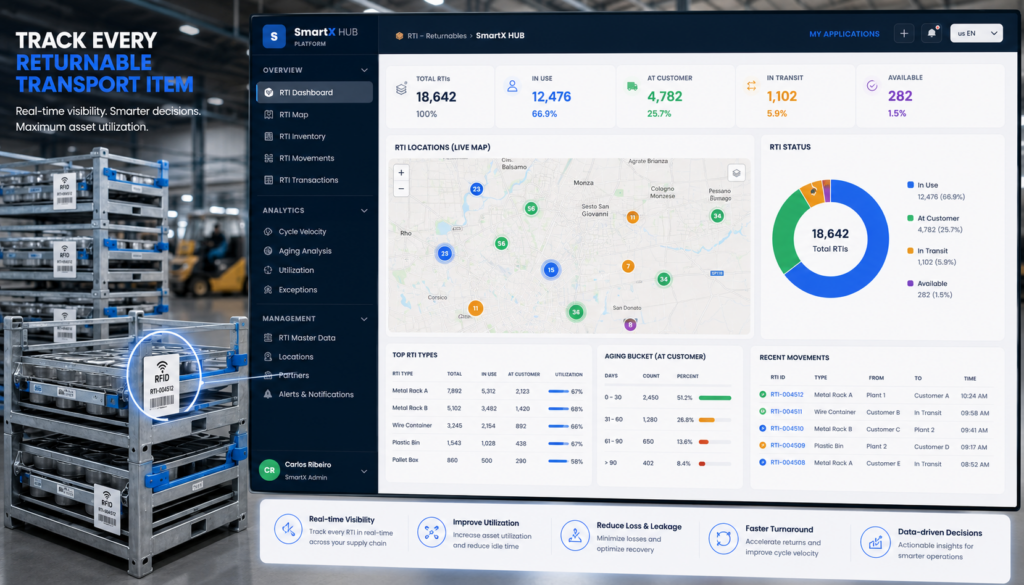
TRACK EVERY RETURNABLE TRANSPORT ITEM
The Impact

What Returnable Container Management Delivers

The SmartX HUB Returnable Container Management module drives measurable improvement across the metrics that matter to a returnable-asset operation.

55–75%
Reduction in reconciliation processes
50–80%
Reduction of one-time packaging
40–65%
Better inventory visibility & cycle counts
10–30%
Savings in inventory carrying cost
10–25%
Lower operations & maintenance costs
10–20%
Improved container turnaround time
5–15%
Shrinkage saved on loss & replacement
5–10%
Reduced returnable container inventory

Ranges reflect typical improvement across returnable-asset operations; actual results depend on baseline, scope, and asset mix.

The Technology

One Container, Every Capture Method

Each container carries a unique ID, and the right technology activates for where it is — factory, customer, or transit. Explore how each works.

Not sure which technology fits your containers? Our RTLS technologies comparison guide weighs range, accuracy, and cost side by side.

Get 100% of your containers geolocated

Tag one container type, track a few cycles, and measure the losses you eliminate and the carrying cost you recover. It's one of the fastest returns in logistics.

Explore our blog for insightful articles, personal reflections and ideas that inspire action on the topics you care about.

FAQ

Returnable Transport Items — Common Questions

Answers to the questions we hear most from teams evaluating RTI and container traceability with SmartX HUB. Have another question? Reach out through our support center.

What are returnable transport items (RTIs), and why track them?
RTIs are reusable containers, pallets, totes, crates and similar assets that cycle between sites, depots and partners. Because they're often under-valued by those who handle them, they suffer high loss and shrinkage. RFID makes each unit visible and accountable — so you stop losing them, right-size your fleet, and keep them working instead of disappearing.
How does RTI tracking work?
Each container gets a unique identifier and can be tracked with RFID, LoRa, BLE or GPS — the right technology activates based on the situation. RFID tags are read at portals, gates, production points or dock doors; BLE beacons cover indoor zones; and GPS or network-based methods extend coverage outdoors and between locations. Whether a unit is in your factory, with a customer or in transit, every movement and status change is captured.
Can it track RTIs across multiple sites and partners?
Yes. SmartX HUB provides real-time multi-site tracking across manufacturing facilities, distribution centers and partner locations, using fixed readers at strategic portals and handheld readers for mobile read points at remote or customer sites. The goal: 100% of your containers geolocated, with no blind spots in between.
How does it reduce shrinkage and container loss?
By tagging each individual unit, SmartX HUB makes every RTI accountable to whoever it passes through. When all users can be held responsible for the units in their facility, shrinkage and losses are curtailed, cycle times are optimized, and inventories can be right-sized and lean — turning a leaky, under-managed asset pool into a controlled one.
Can it automatically flag shortages and trigger replenishment?
Yes. The system highlights shortages and excess stock instantly. Business-rule engines let you set custom alert thresholds and automated replenishment triggers — so when RTIs in an area drop below the minimum, the system knows and can automatically re-order, reducing manual intervention while keeping the right stock in the right place.
Does it give suppliers and partners shared visibility?
Yes. A multi-stakeholder collaboration portal enables secure information sharing across internal departments, external suppliers and logistics partners. A customizable web portal lets each account track their own stock of containers in real time — creating accountability across the whole network and significantly reducing asset leakage.
Does it integrate with our ERP, WMS and MES?
Yes. An API-first architecture with pre-built connectors links SmartX HUB to your ERP, WMS and MES, with data flowing bidirectionally to create a single source of truth for all asset information. It adds a container-traceability layer on top of your existing systems rather than replacing them.
What measurable results can RTI tracking deliver?
Depending on the operation, teams can see up to ~55–75% less reconciliation effort, up to ~50–80% less one-time packaging, improved container turnaround, lower carrying cost and reduced shrinkage. A typical assessment reveals a meaningful share of containers trapped in operational "black holes." Actual figures are validated against your baseline, never presented as a universal guarantee.
Does it offer analytics and predictive insights?
Yes. Beyond simple tracking, SmartX HUB analyzes historical movement patterns to optimize container positioning, predict maintenance needs and identify optimization opportunities. Interactive dashboards turn this into predictive insight and business intelligence — quantifying the financial impact of improvements over time.
How does it connect to my wider logistics operation?
RTI traceability shares one live data layer with the rest of SmartX HUB — working alongside supply chain automation, yard management and real-time location, all on one platform. Containers stay tracked from the trailer they arrive in to their next trip out. Book a demo to map it to your operation.
error: Content is protected !!