
100%
Interval Reached · Work Order Raised
Solution · Preventive Maintenance

Maintenance Plans That Raise Their Own Work Orders

A schedule nobody checks is not a schedule. SmartX HUB triggers preventive work from the calendar and from the meter — runtime hours, cycles, distance — alerting at 90% of the interval and opening the work order automatically at 100%, with the checklist and the parts already attached.

The Challenge & The Solution

The Plan Exists. The Work Did Not Happen.

Every plant has a preventive plan. Most of them live in a spreadsheet that somebody was supposed to check on Monday. The pump that failed had a PM due four weeks ago; the record says it was done, and the person who signed it has left. Preventive maintenance does not fail on strategy — it fails on execution nobody can prove.

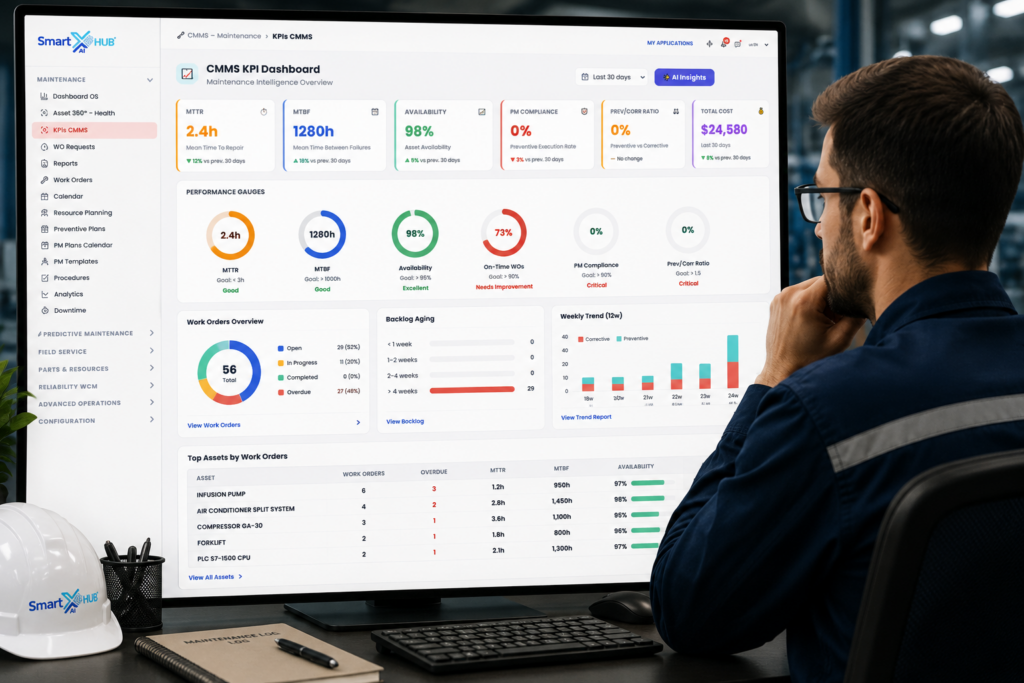
SmartX HUB removes the manual step between the plan and the work. PM Plans fire on a calendar date or on a meter reading, generate the work order with its checklist and parts already linked, and assign the technicians the plan specifies. Compliance stops being a claim and becomes a number on a dashboard, alongside MTBF and MTTR. It works on the same object model as parts inventory and asset management, so a PM that consumes a filter decrements the right bin.

Meter-Based Triggers

Service by Runtime, Not by Wall Calendar

A compressor that ran 40 hours last month does not need the same service interval as one that ran 400. The Meter Dashboard tracks each asset against its own interval as a percentage — runtime hours, cycles or distance. At 90% the responsible technician gets an alert by WhatsApp or email. At 100% the work order opens by itself, with the checklist attached and the parts reserved. Nobody has to remember.
Asset Health 360
The Benefits

Fewer Failures, and Proof You Prevented Them

Preventive maintenance pays off only when the plan executes and the execution is measurable. Five outcomes stand out.

01
Less Unplanned Downtime
Calendar, meter and condition triggers working together catch wear before it becomes a stoppage.
02
No Missed Interval
The work order raises itself at 100% of interval. Compliance stops depending on somebody checking a list.
03
Evidence, Not Assertion
Photos, measurements and signatures live on the work order — the audit trail is a by-product of doing the job.
04
Parts Ready in Advance
The plan knows what it consumes, so the filter is on the shelf when the technician arrives.
05
Measured, Not Assumed
MTBF, MTTR, PM compliance and cost per asset show whether the strategy is working or just running.
The Lifecycle

From Trigger to Closed and Counted

Every preventive work order moves through the same states, so a job on hold for parts is visibly different from one nobody has started.

01
Draft → Open
Raised by the plan, by a meter reading or by a request awaiting pre-approval.
02
Scheduled
Placed on the WO Calendar or the Gantt, where it can be dragged to a new slot.
03
In Progress
Technician works the checklist on a tablet, capturing photos and measurements.
04
On Hold
Waiting for parts or for a vendor — a distinct state, not a silent delay.
05
Completed
Parts consumed and costed, time tracked per technician, signatures captured.
06
Closed
Feeds MTBF, MTTR, PM compliance and the Asset 360 Health risk score.

Work order types cover corrective, preventive, predictive, inspection, emergency and calibration — see maintenance management for the full lifecycle.

Put one asset class on a meter-based plan

Pick the equipment that fails most, set the interval by runtime instead of by date, and measure the change in MTBF after one quarter. That comparison is the business case.

FAQ

Preventive Maintenance — Common Questions

Answers to the questions we hear most from maintenance and reliability teams evaluating preventive maintenance with SmartX HUB. Have another question? Reach out through our support center.

What is the difference between calendar-based and meter-based preventive maintenance?
Calendar-based plans fire on a date — every 90 days, first Monday of the month. Meter-based plans fire on actual use: runtime hours, cycles or distance. A compressor that ran 40 hours last month does not need the same service as one that ran 400, and a date-driven plan either over-services it or misses it. SmartX HUB supports both on the same asset, so a plan can trigger on whichever comes first.
How does the work order get created automatically?
The Meter Dashboard tracks each asset as a percentage of its PM interval. At 90% the responsible technician is alerted by WhatsApp or email. At 100% the work order opens by itself, with the linked checklist attached, the parts identified and the resources the plan specifies already assigned. Nobody has to notice that an interval elapsed.
Can one PM template serve many assets?
Yes. PM Templates are reusable across assets of the same class, so you define the procedure once — checklist, parts, duration, skills required — and apply it to every pump or every conveyor. Changing the template updates the plan going forward rather than requiring an edit per asset.
How do we prove the work was actually done?
The checklist lives on the work order and captures photos, measurements and signatures as the technician completes each step. Time is tracked per technician and parts consumption is costed against the job. The audit trail is a by-product of doing the work, not a separate report somebody assembles afterwards.
What happens when a job is waiting for a part?
It moves to a distinct state. The lifecycle runs draft → open → scheduled → in progress → completed → closed, with on hold, waiting parts, waiting vendor and cancelled as explicit states. A job blocked on a part looks different from a job nobody started — which is the information a supervisor actually needs.
Does preventive maintenance connect to the parts room?
Directly. A PM that consumes a filter decrements the correct bin and captures the cost against the job, because parts and maintenance sit on the same object model. See parts inventory management for the catalog, ledger and count side.
Can sensor readings trigger maintenance before the interval is due?
Yes — that is condition-based work. Wireless sensors feed temperature, humidity and vibration into the same rules engine, and AI anomaly detection flags a trend before a threshold is breached. The result can raise a predictive work order ahead of schedule. Explore predictive analytics and environmental monitoring.
How do we know whether the PM programme is working?
Through MTBF, MTTR, PM compliance and cost per asset. Those four together answer the question a plan alone cannot: are failures actually falling, and what is the strategy costing. Asset 360 Health adds a colour-coded risk view combining open work orders, sensor anomalies, OEE, parts stock and last PM date.
Can technicians work offline or on the shop floor?
Work orders are worked on a tablet at the machine, with the checklist, photo capture and measurements in the same screen. Rescheduling happens on the WO Calendar or the Gantt, where a job can be dragged to a new slot without reopening it.
How is this different from your CMMS page?
The CMMS page covers the whole maintenance platform — every work order type, technicians, vendors, reliability engineering and field service. This page covers the preventive slice specifically: how plans are defined, how they trigger and how compliance is measured. If you are evaluating maintenance software broadly, start with the CMMS page.

Explore our blog for insightful articles, personal reflections and ideas that inspire action on the topics you care about.

Inventory RFID Asset Management 540 x 360 v5 023

Healthcare: Location Intelligence for Cleaning Services

What is RTLS? A Complete Guide to Real-Time Location Systems Real-time location systems (RTLS) track the location of assets,...

Read More
Inventory RFID Asset Management 540 x 360 v6 011

How Much It Costs You Not to Know Where Medical Assets Are

How Much It Costs You Not to Know Where Medical Assets Are Introduction In today's healthcare environment, operational efficiency directly impacts both patient...

Read More
Iot RFID CMMS Inspection 540 x 360 v1 047

Stop Losing Your High-Value Tech: The ROI of Real-Time IT Asset Tracking

Stop Losing Your High-Value Tech: The ROI of Real-Time IT Asset Tracking Introduction Building Intelligent: Real-time IT asset tracking For many...

Read More
Inventory RFID Asset Management 540 x 360 v6 017

Discover the Full Potential of Your RTI Management

Tracking returnable transport items (RTIs) with RFID Introduction Optimize your logistics with advanced RTI Tracking: gain unparalleled visibility, streamline asset management, and...

Read More
Inventory RFID Asset Management 540 x 360 v6 009

Precision at the Bedside: How SmartX HUB and RFID Elevate Patient Care

Asset Tracking for Healthcare Introduction Precision at the Bedside: How SmartX HUB and RFID Elevate Patient Care In the critical moments...

Read More
Inventory RFID Asset Management 540 x 360 v6 000

Safeguarding the Standard: How SmartX HUB and RFID Drive Healthcare Compliance

Asset Tracking for Healthcare Introduction Safeguarding the Standard: How SmartX HUB and RFID Drive Healthcare Compliance In the highly regulated world...

Read More
Inventory RFID Asset Management 540 x 360 v5 026

Precision at the Bedside: How SmartX HUB and RFID Elevate Patient Care

Asset Tracking for Healthcare Introduction Precision at the Bedside: How SmartX HUB and RFID Elevate Patient Care In the critical moments...

Read More
Inventory RFID Asset Management 540 x 360 v5 035

Total Visibility: How SmartX HUB Eliminates the “Invisible Asset” Problem in IT

Total Visibility: How SmartX HUB Eliminates the "Invisible Asset" Problem in IT Introduction Building Intelligent: Asset Management Systems with SmartX HUB ...

Read More
error: Content is protected !!