

EHS Software for Safety That Is Actually Provable
Unsafe conditions do not live in one place, so safety software that lives in one module will always have a gap. A hazardous work permit is issued by maintenance. Protective equipment is managed somewhere else. A near miss between a forklift and a pedestrian is detected by the location engine. A temperature excursion comes from sensors. Waste is recorded against a work order.
SmartX HUB EHS software covers the whole safety lifecycle on one record, which means the seventh stage — proving it happened — is a by-product of the other six rather than a week of work before every audit.
Preventing It Is Half the Job. Proving It Is the Other Half.
Prevent, protect, monitor, detect, respond and learn are the stages every safety programme recognises. The one that decides how an inspection goes is the seventh: proving each of them happened, for a named person, on a specific date, with the evidence attached.
That is where a single platform stops being an architectural preference and becomes a working advantage. The equipment record, the training record and the incident record refer to the same person. The reading, the instrument that took it and that instrument's calibration certificate refer to the same device. Assembling that from four systems is a week of work before every audit. Here it is a set of reports.
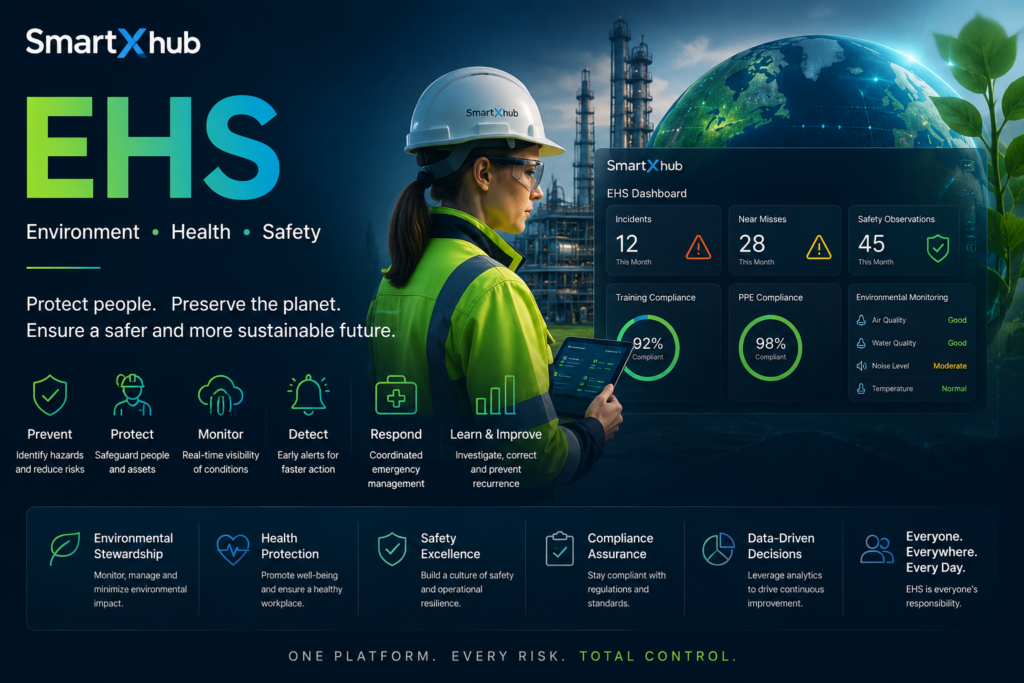
Where EHS Software Has to Reach
Effective EHS software implements each stage below where the work actually happens rather than duplicating it inside a safety silo. The permit lives with maintenance because that is where hazardous work is planned. Exposure monitoring lives with sensors. Proximity detection lives with the location engine. What makes it one programme instead of five is that they share one workforce identity, one asset register, one audit trail and one timestamp source. Practices align with the management-system thinking behind ISO 45001.
Prevent
- Job hazard analysis that can be revised when conditions change, rather than a read-only reference nobody trusts
- Toolbox talks recorded with subject, date, who delivered and who attended — the first evidence requested after an incident
- Permit to work in four types — isolation, confined space, hot work, work at height — each with its own signed checklist, and the permit gates the job
- Competency with recertification tracking and gap analysis that reflects live enrolment, not the last time a report ran
Per-type checklists are the design decision that matters. A confined-space entry and a hot-work permit have almost nothing in common, and one generic form is how the specific control that would have prevented the incident gets skipped.
Protect
- Protective equipment assigned by risk group, so a change to the assessment updates everyone in that group instead of hundreds of individual records
- Equipment certificates validated against the issuing registry rather than merely stored, which is what catches one revoked after issue
- A failed inspection auto-opens a ticket, so a condemned harness becomes a tracked replacement instead of a note
- Exposure limits for heat, cold and other time-bound conditions, with shift adherence tracked against the configured limit
Monitor
The environmental half of EHS, which is where most consolidated programmes are weakest because a different team implements it.
- Temperature, humidity, air quality and gas detection across the estate
- Personal climate — conditions where people are, not where equipment is
- Zone rules for must-not-enter, curfew and maximum dwell, evaluated against real presence
- Probe calibration verifiable, because a reading from an uncalibrated instrument proves nothing
The same sensor answers two different questions with two different thresholds. A cold room at minus eighteen is correct for the product and a regulated exposure for the person standing in it.
Environmental monitoringDetect and Respond
- Near misses detected automatically from proximity between tracked entities, typed and graded by severity, giving a frequency rate you can trend rather than a count of what got reported
- Lone worker and no-motion detection, with the escalation routed by rule rather than to a hard-coded recipient
- Live mustering with playbooks and assembly points, ranking time to muster per person and naming whoever has not arrived
- Drill history recorded the same way as live events, so practice is measurable
An Incident That Produces a Report and No Change Produces the Same Incident Again
Investigation is where most EHS software stops being useful, because the analysis lands in a document and the document lands in a folder nobody reopens. Here the finding becomes tracked work with an owner and a date, linked to the asset it belongs to.
Root cause, structured
Five whys and an Ishikawa diagram on the investigation record itself, not a free-text field pretending to be an analysis. Every investigation joins the asset's permanent history, so the next person sees what already happened to this machine.
Risk scored, then re-scored
Failure modes carry severity, occurrence and detection producing a risk priority number. Corrective actions carry their own re-scored values, so the system records not only what should be done but how much doing it actually reduced the risk. Revision history makes risk trend auditable rather than reconstructed.
Capture without a separate step
A checklist step flagged as an anomaly during a routine inspection raises a tracked tag automatically. Shop-floor capture does not depend on someone remembering to log it separately, which is the step that never survives a busy shift.
A QR code per asset or location that anyone can scan — no login, no app, no account. A visitor, a contractor or an employee without a system login can raise a real, trackable issue from a hallway sign. Submissions enter a review queue where a key user converts a legitimate report into a ticket or a work order without re-typing it. For an EHS programme this is the channel that captures what would otherwise be mentioned to a supervisor in passing and forgotten by lunchtime.
What an Audit Asks For, and Where It Comes From
This is the test worth applying to any EHS software you evaluate. The point is not that each of these records exists somewhere. It is that they share one workforce identity, one asset register and one audit trail — so the equipment record, the training record and the incident record refer to the same person, and a reading, the instrument that took it and that instrument's certificate refer to the same device. Assembling that from four systems is a week of work before every inspection. Here it is a set of reports.
| The inspector asks for | Produced by |
|---|---|
| Evidence of hazard analysis before the work started | Job hazard analysis and the work permit |
| Evidence the crew was briefed on that hazard that morning | Toolbox talk records with attendance |
| Evidence protective equipment was issued and accepted | Signed issue records, permanently stored |
| Evidence those equipment certificates are still valid | Certificate validation against the issuing registry |
| Evidence of competency for the task performed | Training certificates and gap analysis |
| Evidence of exposure compliance | Exposure violations and shift adherence against the configured limit |
| The incident and near-miss record | Reported incidents, plus near misses detected automatically |
| Evidence that evacuation actually works | Mustering history and the drill audit |
| Corrective action and what effect it had | Root cause analysis, risk scoring with measured reduction, improvement cycles |
| The instrument validity behind any reading | Calibration certificates, sealed and verifiable |
Bring the Question You Cannot Answer Before an Audit
Tell us which evidence takes longest to assemble today and we will show where it comes from when prevention, monitoring, response and investigation share one record.
EHS Software — Common Questions
What safety managers, operations leads and auditors ask most, including the things this platform deliberately does not do.