One Record · Dock to Delivery
Logistics · Distribution · RFID · RTLS

RFID & RTLS in Logistics: 26 Processes from Dock to Delivery

From the receiving dock to proof of delivery, a single scan can update inventory, location, custody, a shipment, an alert, and your WMS — all at once. This guide maps the 26 logistics and distribution processes where connected tracking turns movement into measurable control.

14 min read 6 domains · 26 processes

A distribution center is a river of constant movement — trucks arriving, pallets being received, goods stored, orders picked, loads shipped, vehicles leaving, returnables coming back. In most operations, each of those stages lives in its own island of data: receiving in one system, the yard on a whiteboard, deliveries on paper, returnable assets nowhere at all. Every hand-off between islands is where accuracy, time, and money leak away.

The shift happening across modern logistics is not "add more scanners." It is treating every physical event — a tag read at a dock, a truck crossing a geofence, a signature at delivery — as a single trigger that updates everything downstream at once: inventory, location, custody, the order, the alert, and the WMS. That is what separates a real-time operation from one that finds out what happened yesterday.

One Event → End-to-End Visibility
Identify Receive Store Pick Ship Deliver Return Integrate
RFID · BLE · GPS · LoRaWAN · QR/NFC · IoT Sensors — one capture layer feeding one operational record

The choice of technology — RFID, Bluetooth, LoRaWAN, UWB, GPS, QR/NFC, or IoT sensors — is just the capture method. What matters is that the event lands in one place and drives every downstream action, and integrates with the ERP, WMS, or TMS you already run. If you're weighing which capture technology fits which stage, our RTLS technologies comparison guide breaks down the trade-offs.

Below, the 26 processes are grouped into six domains that follow the flow of goods through a distribution operation. You don't need all of them — most operations start with one or two high-pain areas, prove the value, then expand. Use this as a map to find where connected tracking pays off fastest.


The Logistics Value Map

Six Domains, One Platform

Every one of the 26 processes belongs to one of these six domains, following goods from the inbound dock all the way back to returns. Find the domain that matches your biggest operational pain — that's where to start.

Inbound
Receiving, GRN, dock scheduling, and putaway. The front door of the operation — where accuracy is either won or lost for everything downstream.
Faster, more reliable receiving
Warehouse
Inventory, asset location, picking, and packing. The core of the operation, where real-time location and RFID counts replace slow manual work.
Higher accuracy · less search time
Outbound
RFID shipping validation, manifests, route and delivery management, and proof of delivery. Making sure the right goods leave and arrive with evidence.
Higher OTIF · fewer disputes
Yard & Fleet
Yard management, gate control, fleet and forklift management, and vehicle maintenance. Controlling everything with wheels, inside and outside the gate.
Lower dwell · higher availability
Returnables
Returnable transport items, asset custody, and equipment reservations. Stopping the quiet, constant loss of pallets, racks, crates, and containers.
Fewer losses · faster cycles
Safety & IoT
Cold chain, environmental monitoring, worker safety, mustering, audits, and enterprise integration. Protecting people, product, and data.
Compliance · protection · integration
The 26 Processes

Where Connected Tracking Pays Off

Each process below pairs a real operational challenge with the outcome connected tracking delivers. Expand a domain to see the processes inside it.

1
Receiving & GRN
Replace manual receiving — a source of delays and discrepancies — with created orders, prepared items, printed labels, RFID scan validation, and a completed goods-received note that syncs to the ERP from the dock.
Receiving timeDiscrepanciesAccuracy
2
Dock Scheduling
Turn unscheduled arrivals and idle docks into a managed flow with a dock calendar, priority, check-in, live status, and time-by-stage — cutting queues and improving dock utilization.
Wait timeDock occupancyTurnaround
3
Putaway & Location Management
Stop products landing in the wrong location. Suggest the right slot, validate it with a scan, and update inventory instantly for higher accuracy and speed.
Putaway timeErrorsProductivity
4
RFID Inventory
Replace slow, error-prone manual counts with RFID blind counting, reconciliation, exception handling, and area audits — for faster, more reliable inventories.
AccuracyInventory timeNot-seen items
5
Asset & Material Location
Find pallets, equipment, and materials fast with a live map, last read, current zone, movement history, and alerts — cutting search time and raising visibility.
Search timeAssets foundDwell time
6
Picking
Cut picking errors and rework with a digital pick list, optimized route, scan validation, and exception control — raising both speed and accuracy per order.
ProductivityPicking errorsTime per order
7
Packing
Prevent packages being closed with the wrong items through item validation, packaging, labeling, weight check, and closure confirmation — fewer errors before shipping.
Packing errorsTimeRework
8
RFID Shipping
Stop incomplete or incorrect loads leaving with automatic RFID portal validation, manifest comparison, and alerts — for safer, faster shipping.
AccuracyLoad timeErrors avoided
9
Proof of Delivery (PoD)
Give every delivery reliable evidence — signature, photo, date, location, recipient, and exception handling — for end-to-end traceability and fewer disputes.
Confirmed deliveriesReturnsDiscrepancies
10
Route & Delivery Management
Keep control when routes and priorities change with planning, sequencing, live status, geofences, and proof of delivery — improving OTIF and productivity.
OTIFStopsDelay
11
Yard Management
Turn a yard full of vehicles with unknown status into a managed operation with check-in, geofences, slot and queue control, dock assignment, and stage timing — cutting congestion and waiting.
Dwell timeQueueTurnaround
12
Gate Control
Replace manual entry logs with pre-registration, credentials, and vehicle, driver, and load capture with evidence — for more security and smoother flow.
Entry timeDenied accessDocumentation
13
Fleet Management
Bring visibility to vehicle use, location, and maintenance with a registry, GPS, geofences, utilization tracking, alerts, and history — for higher availability and control.
UtilizationIdle timeAvailability
14
Fleet Maintenance
Unify failures and preventive plans with work orders, plans, parts, labor, checklists, and history — reducing downtime and improving planning by vehicle.
MTTRBacklogCost per vehicle
15
Forklift & Equipment Management
Stop handling equipment sitting idle or unavailable with custody, location, inspection, maintenance, and utilization tracking — for better use and safety.
AvailabilityUsageDowntime
16
Returnable Assets & RTI
Stop losing pallets, crates, racks, and containers across the chain with identification, shipping and receiving events, cycle tracking, balance, and aging — for fewer losses and faster cycles.
Return rateCycleBalance by customer
17
Asset Custody
Keep accountability when assets transfer between people and sites with checkout, transfer, return, signature, and due dates — reducing delays and losses.
DelaysLossesAssets per owner
18
Equipment Reservations
End conflicts over shared equipment with a calendar, approvals, pickup, return, and alerts — improving availability and cutting no-shows.
ConflictsUtilizationNo-show
19
Cross-Docking
Move products across the DC with minimal storage through identification, order association, staging, and rapid shipping — lowering operational time and cost.
Time in DCErrorsProductivity
20
Reverse Logistics
Bring order to returns with receiving, reason capture, inspection, destination routing, credit, and evidence — for more control and value recovery.
Return timeRecoveryDiscrepancies
21
Cold Chain
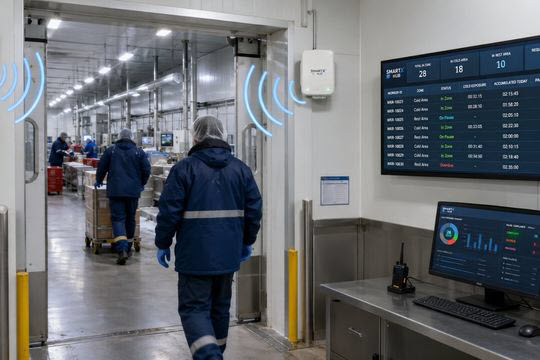
Protect sensitive products with continuous sensor monitoring, thresholds, alerts, history, and shipment evidence — for product protection and compliance.
ExcursionsTime out of rangeResponse
22
Environmental Monitoring
Keep warehouse temperature and humidity in range with sensors, rules, escalation, maps, and reports — for greater operational stability.
CoverageExcursionsResponse
23
Worker Safety
Protect operators working near mobile equipment with SOS, man-down, geofences, no-go zones, and near-miss detection — for greater workforce protection.
IncidentsResponse timeViolations
24
Mustering & Emergencies
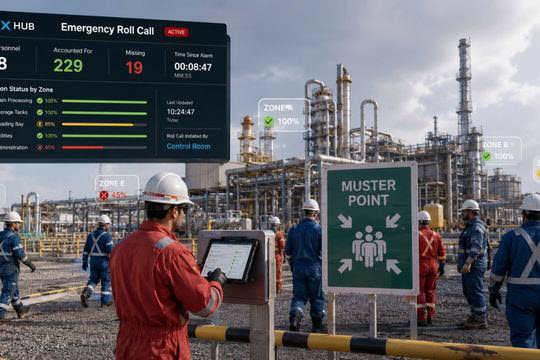
Replace slow manual headcounts with real-time counts, muster points, and last known location — for faster, safer emergency response.
Evacuation timePeople accounted for
25
Audits & Checklists
Standardize inspections with digital checklists, photos, nonconformities, CAPA, and signatures — for consistent evidence and traceability.
ComplianceFindingsClose time
26
ERP, WMS, TMS & API Integration
Unify fragmented logistics data with REST APIs and webhooks that synchronize orders, inventory, deliveries, and assets — automating without replacing existing systems.
Sync errorsAutomationExceptions
Where to Begin

Start Small, Prove It, Then Expand

You don't deploy 26 processes on day one. The proven path is to pick one high-pain area, run a focused proof of concept, measure the delta against your baseline, and expand from there. These six starter bundles are the most common entry points.

RFID Warehouse Starter
Receiving, inventory, picking, shipping, and reports — the core warehouse flow.
Yard Visibility Starter
Check-in, queues, geofences, docks, and dwell time — control of the yard.
Delivery & PoD Starter
Routes, status, signature, photo, and discrepancies — proof at every drop.
RTI & Returnables Starter
Cycle, balance, aging, losses, and returns — stop the quiet leak of assets.
Cold Chain Starter
Sensors, thresholds, alerts, and evidence — protect temperature-sensitive goods.
Integrated Operations
Warehouse, Yard, Fleet, RTI, Safety, and integrations — the full platform.
The Proof-of-Concept Path
Prove value before you scale — build the business case from your own measured data, not generic promises.
1
Scope
1–3 representative operations
2
Baseline
Document the current method
3
Configure
Workflows, rules, exceptions
4
Measure
Before vs. after performance
5
Expand
Roll out across the network
Building the Business Case

How to Measure Real ROI

Credible ROI is a measurement plan, not a fixed guarantee. The pattern is always the same: capture a baseline, run the SmartX-enabled process, measure the delta, and annualize it. In logistics, the value tends to come from six directions:

Inventory — accuracy gained, and hours saved on counting and reconciliation. Receiving & shipping — reduced time per load, fewer errors, shorter queues. Yard — lower dwell time and better dock use. Returnables (RTI) — recovered assets and avoided repurchases. Deliveries — protected revenue through higher OTIF and fewer disputes. Safety & cold chain — avoided losses and lower exposure.

Add those savings, subtract the annual software, hardware, and services cost, and you have a defensible annual value — built entirely from the customer's own numbers. For a full worked example of this method, see our guide on building an RFID ROI business case.

Find your starting point

Pick the one stage costing you the most today — receiving delays, yard congestion, lost returnables, delivery disputes — and see what a focused proof of concept could prove in weeks, not quarters.

Frequently Asked Questions

Logistics RFID & RTLS, Answered

RFID is used across logistics to identify and track goods, pallets, returnables, and vehicles without line-of-sight scanning. A single RFID read at a dock portal can validate a shipment, update inventory and location, confirm custody, and sync with the WMS — automating receiving, inventory counts, shipping validation, and returnable-asset tracking from dock to delivery.

RFID identifies items as they pass fixed read points, like dock portals or gates — answering "what passed here, and when." RTLS (real-time location systems) continuously tracks where things are on a live map — answering "where is it right now." Warehouses often use both: RFID for high-volume validation at choke points, and RTLS for locating assets, forklifts, or people anywhere in the facility.

Start with the single stage costing you the most today — usually inventory accuracy, yard dwell time, lost returnables, or delivery disputes. Run a focused proof of concept on one operation, measure the result against a baseline, and expand from there. Trying to deploy everything at once is the most common reason logistics projects stall.

No — it integrates with them. The platform connects to ERP, WMS, and TMS through REST APIs and webhooks, synchronizing orders, inventory, deliveries, and assets. Your existing systems can remain the authoritative source; SmartX HUB adds the real-time physical-event layer — the reads, locations, and evidence — that those systems can't capture on their own.

RFID lets you count hundreds of items at once without line-of-sight, so a full inventory that took hours of manual scanning takes minutes. Blind counting, automatic reconciliation, and exception handling catch discrepancies immediately rather than at month-end. The result is far higher accuracy, less labor, and inventory data your planning systems can actually trust.

Yes — that's the core advantage of a unified platform. When receiving, inventory, yard, fleet, deliveries, returnables, and safety share one operational record, a single physical event updates all of them at once. This eliminates the disconnected islands of data — receiving in one system, the yard on a whiteboard, deliveries on paper — that cause delays, errors, and blind spots.

Keep Exploring

Related Guides

Go deeper on the technologies behind these 26 processes: our RTLS technologies comparison guide weighs RFID, BLE, UWB, LoRaWAN, and GPS side by side; the RFID technology page covers passive tagging for inventory and shipping; the LoRaWAN page covers long-range coverage for yards and cold chain sensors; and for the manufacturing side of the operation, see our companion guide to RFID and IoT in manufacturing.

More Related Topics

Explore our blog for insightful articles, personal reflections and ideas that inspire action on the topics you care about.