Safe Zone
Cross the Boundary · Trigger the Alert
Manufacturing · Safety & Workforce

Connected Worker Safety: Real-Time Protection on the Floor

When something goes wrong on an industrial site, minutes matter. Connected worker safety uses wearable tags and real-time location to know where every person is, detect danger the moment it happens, and get help to them fast — while building the compliance evidence to prove it.

10 min read Safety & Workforce series
The Short Answer

What Is Connected Worker Safety?

Quick Answer

Connected worker safety uses wearable tags, real-time location, and IoT sensors to protect people on industrial sites. It gives supervisors live visibility of where every worker is, automatically detects hazards — a fall, an SOS, entry into a restricted zone — and alerts responders instantly, while logging the data needed to prove compliance and investigate incidents.

Traditional site safety relies on procedures, signage, and periodic checks. Those matter — but they're passive. They can't tell you that a lone worker in a remote area hasn't moved in fifteen minutes, that someone just entered a zone they're not certified for, or exactly who is still inside a building during an evacuation.

Connected worker safety makes safety active and real-time. Each worker wears a small tag — on a badge, wristband, or helmet — that reports location and can detect events like falls and no-motion. Combined with a platform that applies safety rules and raises alerts, the site gains a live picture of its people and the hazards around them. It's one of the most important processes in the wider set of RFID and IoT manufacturing processes, because it protects the one asset that matters most.


Core Capabilities

What Connected Safety Actually Does

A connected worker safety system combines several protective functions on one platform. Each addresses a specific, well-known industrial risk.

Geofencing & Restricted Zones
Define virtual boundaries around hazardous areas — high-voltage rooms, confined spaces, crane zones. Get an instant alert when a worker enters a zone they're not authorized or certified for.
SOS Panic Button
A press of the wearable's button sends an immediate distress signal with the worker's exact location to supervisors and the control room — turning a cry for help into a precise, actionable alert.
Man-Down & Fall Detection
Motion sensors in the tag detect a sudden fall or a prolonged lack of movement, automatically raising an alarm even when the worker can't — critical for slips, collapses, and medical events.
Lone Worker Monitoring
Workers operating alone in remote or isolated areas are monitored automatically. If check-ins are missed or no motion is detected for a set time, the system escalates before a small problem becomes a tragedy.
Vehicle & Pedestrian Proximity
Detect when a worker on foot gets too close to a forklift or moving vehicle, warning both parties in real time. One of the highest-impact ways to prevent a common and serious class of industrial accident.
Emergency Mustering
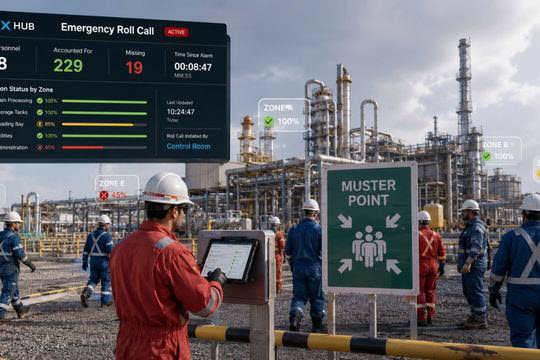
During an evacuation, a live dashboard shows who has reached the assembly point and who is still inside — replacing paper roll-calls with an instant, accurate headcount when seconds count.
How It Works

The Right Technology for Each Environment

Worker safety spans very different spaces — tight indoor cells, sprawling outdoor yards, GPS-denied tunnels. No single tracking technology covers them all, which is why connected safety systems mix them on one platform.

Indoor Zones
BLE & RFID
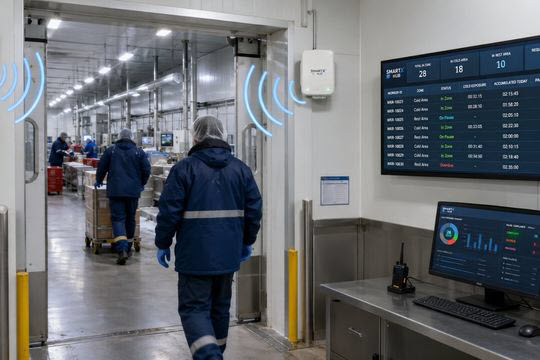
For room- and zone-level presence indoors — knowing which area a worker is in, and enforcing restricted-zone rules — Bluetooth tags and gateways are cost-effective and battery-efficient. Ideal for factory floors, wards, and warehouses.
High Precision
UWB
Where you need to know a worker's exact position — for vehicle-proximity warnings or precise exclusion zones around machinery — UWB delivers sub-meter accuracy in real time.
Large / Outdoor
LoRaWAN & GPS
For remote workers, large yards, and areas with no cellular coverage, LoRaWAN wearables report location and SOS over kilometers on years of battery, while GPS covers open outdoor movement.

Whatever the capture technology, the data flows to one platform that applies the safety rules, raises alerts, and shows every worker on a live map. To weigh the trade-offs between technologies for a specific site, our RTLS technologies comparison guide breaks down accuracy, range, and cost side by side.

Why It Matters

Protection and Proof

Connected worker safety delivers value in two directions at once: it prevents and mitigates incidents in real time, and it produces the objective record that safety-driven organizations need.

Real-Time Protection
  • Faster emergency response — help finds the person, with an exact location
  • Fewer restricted-zone incidents through automatic access alerts
  • Vehicle-pedestrian collisions prevented with proximity warnings
  • Lone workers no longer invisible between check-ins
  • Accurate, instant headcount during evacuations
Compliance & Evidence
  • Automatic records of who was where, and when, for every shift
  • Zone-time logs that demonstrate exposure control to auditors
  • Objective incident data for faster, fairer investigations
  • Near-miss data to fix hazards before they cause harm
  • Evidence that supports EHS programs and regulatory reporting

Protect your team in real time

Start with one high-risk area — a confined space, a busy forklift zone, a group of lone workers — and see how real-time location turns safety from paperwork into protection.

Frequently Asked Questions

Connected Worker Safety, Answered

Connected worker safety uses wearable tags, real-time location, and IoT sensors to protect people on industrial sites. It gives supervisors live visibility of where workers are, automatically detects hazards such as falls, SOS presses, and restricted-zone entries, and alerts responders instantly — while logging the data needed to prove compliance and investigate incidents.

A lone worker wears a tag that reports location and detects movement. If the worker misses a scheduled check-in, presses an SOS button, or the tag detects a fall or a prolonged lack of motion, the system automatically escalates — alerting supervisors with the worker's last known location. This ensures someone working alone in a remote or isolated area is never truly invisible.

It depends on the environment. BLE and RFID handle indoor zone-level tracking cost-effectively; UWB provides sub-meter precision for exact positioning and vehicle-proximity alerts; LoRaWAN and GPS cover remote workers and large outdoor sites where cellular coverage is unreliable. Most sites combine several technologies feeding a single safety platform.

Every location event, zone entry, alarm, and evacuation is logged automatically with a timestamp. This creates an objective record that demonstrates exposure control, supports EHS programs and regulatory reporting, and provides clear evidence for incident investigations. Instead of reconstructing events from memory and paperwork, safety teams have accurate data.

Emergency mustering is the process of accounting for everyone during an evacuation. In a connected safety system, wearable tags are detected at assembly points, so a live dashboard shows in real time who has reached safety and who may still be inside. This replaces slow, error-prone paper roll-calls with an instant, accurate headcount when every second matters.

Keep Exploring

Related Guides

Connected worker safety is one of 26 processes in our complete guide to RFID and IoT in manufacturing. The location technology behind it is covered in depth on our LoRaWAN, UWB, and Bluetooth AoA pages, and the RTLS technologies comparison guide weighs them side by side to help you choose the right fit for each area of your site.

More Related Topics

Explore our blog for insightful articles, personal reflections and ideas that inspire action on the topics you care about.