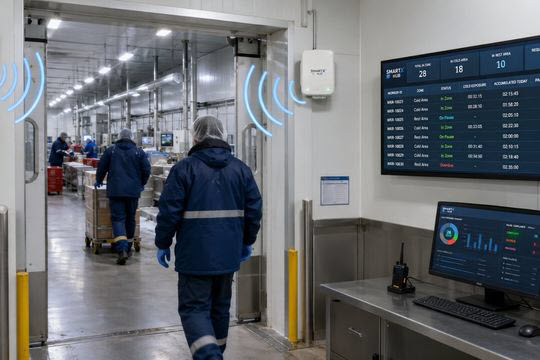
Every Station Stamps a Timestamp
Manufacturing · Production & WIP

What Is WIP Tracking? A Guide to Real-Time Work-in-Progress Visibility

Most manufacturers can't answer a simple question: "where is order #4471 right now?" WIP tracking replaces guesswork and clipboards with automatic, real-time visibility of every part, lot, and order as it moves through production.

9 min read Production & WIP series
The Short Answer

What Is WIP Tracking?

Quick Answer

WIP tracking (work-in-progress tracking) is the practice of monitoring parts, lots, pallets, and orders in real time as they move through each stage of production. Using RFID, barcodes, or IoT sensors, every entry and exit at a workstation is recorded automatically — so you always know where each order is, how long it has spent at each step, and where it's stuck.

"Work in progress" is everything on your shop floor that has started production but isn't finished yet — raw material that's been released, sub-assemblies moving between cells, orders waiting in a queue. In most factories, this inventory is a black box. Once material leaves the warehouse, its status lives in operators' heads, on paper travelers, or in a spreadsheet updated hours later.

WIP tracking makes that black box transparent. Each part or order carries an identifier — an RFID tag, a barcode, or an NFC label. Fixed readers or handheld scanners at each station capture the item as it arrives and leaves, timestamping every movement. Instead of asking three people where an order is, you open a dashboard and see it on a live floor plan, along with how long it's been sitting.

This is one of the highest-impact processes in the broader set of RFID and IoT manufacturing processes — because it attacks the two things every plant manager cares about most: lead time and traceability.

How It Works

From Tag to Live Dashboard

WIP tracking follows a simple loop that repeats at every station on the floor. No manual data entry, no waiting for shift-end reports.

STEP 01
Identify
Each part, lot, pallet, or order gets an RFID tag, barcode, or NFC label linking it to its production order in the system.
STEP 02
Capture
Fixed readers or handhelds at each station record entry and exit automatically — no operator has to stop and type anything in.
STEP 03
Timestamp
Every movement is stamped with a time and station, building an exact record of how long each order spends at each step and in each queue.
STEP 04
Visualize
A live dashboard shows every order's location, status, and dwell time — and syncs back to your ERP or MES as the single source of truth.
The Payoff

What WIP Tracking Lets You Measure

The value isn't the tracking itself — it's the decisions the data unlocks. Once every movement is timestamped, metrics that used to be estimates become facts.

Lead Time
See the true end-to-end time for every order — not a planning estimate. Spot which product families and routings run long, and quote delivery dates with confidence.
Bottlenecks & Queues
Dwell-time data reveals exactly where orders pile up and wait. Instead of debating which station is the constraint, you see it — and can rebalance the line with evidence.
Traceability
Full genealogy of every order — which materials, which operators, which machines, in what sequence. Essential for recalls, audits, and quality investigations.
Rework & Scrap
Track which orders loop back through a station and how often. Rework that was invisible in aggregate reports becomes a measurable, targetable number.
Stalled Orders
Automatic alerts when an order sits longer than expected at any step — so problems surface in minutes, not at the end of the shift when it's too late to react.
Accurate ERP/MES Data
Production status flows into your ERP or MES as it happens — no manual back-flushing, no reconciliation. Planning works from reality instead of yesterday's snapshot.
Do You Need It?

Signs Your Floor Is Flying Blind

WIP tracking earns its keep fastest in plants with these symptoms. If more than a couple sound familiar, it's worth a closer look:

"Where is this order?" is answered by walking the floor or making phone calls.
Lead-time quotes to customers are guesses padded with safety margin, not data.
You discover an order is late only when the customer calls to ask about it.
A quality issue means hours of paper-chasing to trace which orders are affected.
Everyone "knows" which station is the bottleneck, but no one can prove it with numbers.
Your ERP shows production status that is hours or a full shift behind reality.
Choosing the Capture Technology

Which Technology Tracks WIP Best?

There's no single "right" technology — it depends on your parts, environment, and how precisely you need to locate things. Most plants use a combination:

Passive RFID is the workhorse for WIP. Tags are cheap, need no battery, and read automatically at station portals without line-of-sight — ideal for high-volume parts and pallets passing fixed points. Learn more on our RFID technology page.

Barcodes / QR / NFC are the lowest-cost entry point when a quick manual scan at each station is acceptable — common for low-volume, high-mix production.

BLE and UWB add real-time location on top of station check-ins, so you can see where an order is between stations, not just at them. UWB gives centimeter precision for high-value or fast-moving WIP; see the UWB and Bluetooth AoA pages. For a full side-by-side, our RTLS technologies comparison guide weighs accuracy, cost, and range.


See your floor in real time

Start with one line, tag a representative set of orders, and measure the lead-time and bottleneck data you've never had before. That's a proof of concept, not a leap of faith.

Frequently Asked Questions

WIP Tracking, Answered

WIP tracking (work-in-progress tracking) is the real-time monitoring of parts, lots, and orders as they move through production. Each item carries an RFID tag, barcode, or NFC label, and readers at each station record entry and exit automatically. This gives manufacturers live visibility of where every order is, how long it spends at each step, and where it's delayed — replacing paper travelers and shift-end reports.

Inventory generally refers to raw materials waiting to be used and finished goods ready to ship. Work-in-progress (WIP) is everything in between — material that has started production but isn't complete, including sub-assemblies and orders moving between stations. WIP is harder to track because it's constantly moving, which is exactly why automatic WIP tracking adds so much value.

Each part, pallet, or order is tagged with an RFID label linked to its production order. Fixed RFID readers at workstations, or handheld readers, detect the tag automatically as it enters and leaves each station — without line-of-sight or manual scanning. Every read is timestamped and sent to the platform, which maps the order's location, calculates dwell time, and updates the ERP or MES in real time.

The most common are lead time, time-per-station, queue time by process, rework rate, and the number of stalled orders. Because every movement is timestamped, these shift from planning estimates to measured facts — letting you quote accurate delivery dates, identify true bottlenecks, and react to delays as they happen rather than after the shift ends.

Both work. Barcodes and QR/NFC are the lowest-cost option when a quick manual scan at each station is acceptable — good for low-volume, high-mix production. Passive RFID reads automatically without line-of-sight, which suits high-volume parts and pallets passing fixed portals. Adding BLE or UWB gives real-time location between stations, not just at them. Many plants combine methods on one platform.

Keep Exploring

Related Guides

WIP tracking is one of 26 processes in our complete guide to RFID and IoT in manufacturing. To go deeper on the capture technologies behind it, see the RFID technology page for passive and active tagging, the UWB and Bluetooth AoA pages for real-time positioning, or the RTLS technologies comparison guide to weigh all the options side by side.

More Related Topics

Explore our blog for insightful articles, personal reflections and ideas that inspire action on the topics you care about.