Detection
Detect and respond: the stage that depends on people telling you
Near-miss reporting is the leading indicator most EHS management programmes claim and few genuinely have. The reason is structural rather than cultural: reporting costs the reporter time and, in some organisations, exposes them to questions. Not reporting costs nothing. A system relying purely on voluntary reporting measures the willingness to report, not the frequency of near misses — and those two numbers move independently.
Two changes address it. The first is lowering friction until reporting is genuinely easier than not reporting — a scannable code on a hallway sign that anyone can use with no login, no app and no account, so a visitor or contractor with zero system access can raise a real, trackable issue. That single decision captures the events otherwise mentioned to a supervisor in passing and forgotten by lunchtime.
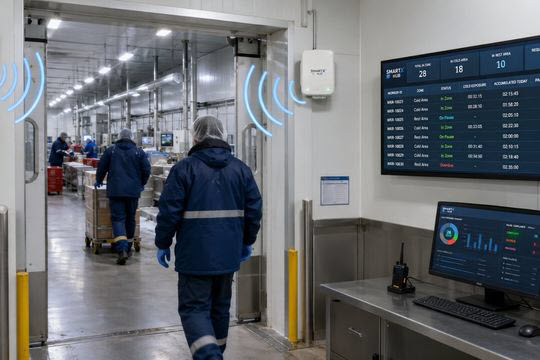
The second is detecting what can be detected. Where people and vehicles carry location tags, proximity below a threshold is recorded automatically, typed by the kind of pair involved and graded by severity. That produces a near-miss frequency rate you can trend. It does not replace reporting — an event involving an untracked object or an unbadged visitor is invisible to it — but it removes the dependency on somebody choosing to speak up before you know anything at all.
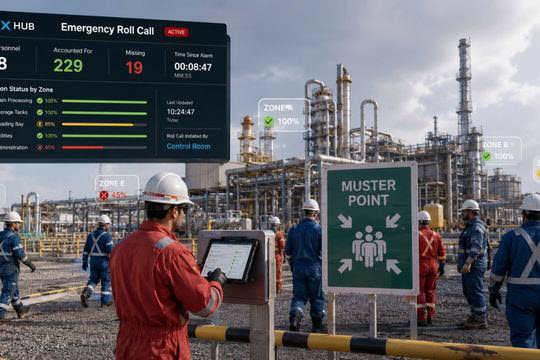
Response has its own version of the same problem. During an evacuation the useful question is not how many people reached the assembly point but who has not. Manual roll call struggles there for a reason unrelated to the competence of whoever holds the clipboard: their list was accurate at the start of the shift and the site was not. Contractors arrived, someone left early, and a visitor is in a meeting room on the second floor appearing on no list at all.
Starting from a live on-site count changes the shape of the response — effort goes to the four people unaccounted for rather than confirming the two hundred already outside. And because drills can be recorded like live events, evacuation becomes measurable. Most organisations run drills and record only that a drill occurred, which proves attendance rather than readiness. See emergency roll call.
Evidence
Learn and prove: an incident that produces a report and no change produces the same incident again
Investigation is where EHS management most often becomes ceremonial. The analysis is performed, a document is produced, the document is filed, and eighteen months later a similar event occurs in a similar way. The failure is not in the analysis. It is that the analysis and the corrective work live in different places, so nobody can tell whether the finding ever became anything.
A structured investigation — five whys, a cause diagram — is worth doing on the record itself rather than in a free-text field pretending to be an analysis, because a structure that can be queried later is what turns individual investigations into a trend. And the finding has to become tracked work with an owner and a date, linked to the asset it concerns, or it is a suggestion.
Risk scoring deserves a specific mention. Scoring failure modes by severity, occurrence and detection is common practice. Re-scoring them after the corrective action is not, and it is the step that converts a risk register from a list of concerns into a measure of whether the programme is working. Without the second score you know what you intended to do. With it you know how much doing it actually reduced the risk.
The most reliable sign of a maturing programme is not fewer incidents. It is more near misses and more safety observations, with incidents falling. A reporting rate that rises while injuries fall means people are telling you things earlier.
Which brings us to the seventh stage. Here is the practical test: take any row below and time how long your organisation needs to produce that evidence for a specific person on a specific date. Not whether you could eventually. How long.
| The inspector asks for |
Comes from |
| Evidence of hazard analysis before the work started | Hazard analysis and the work permit |
| Evidence the crew was briefed on that hazard that morning | Toolbox talk record with attendance |
| Evidence protective equipment was issued and accepted | Signed issue record |
| Evidence those certificates are still valid today | Validation against the issuing registry |
| Evidence of competency for the task performed | Training records and gap analysis |
| Evidence that evacuation works | Muster history and the drill audit |
| Corrective action and what effect it had | Investigation, re-scored risk, improvement cycle |
| The instrument validity behind any reading | Calibration certificate for that device |
The point is not that each of these records exists somewhere. In most organisations they all do. The point is whether they refer to the same things — whether the equipment record, the training record and the incident record are about the same person, identified the same way, and whether a reading, the instrument that took it and that instrument's calibration certificate resolve to the same device. When they do not, proving compliance means reconciling four systems by hand, and doing it again before the next inspection.
Where SmartX HUB goes beyond a classic EHS system
Most EHS tools record what people type into them. SmartX HUB runs the safety lifecycle on the same record as tracking, maintenance and sensors — so a permit can gate the work order it governs, a failed equipment inspection opens a ticket automatically, proximity between a person and a vehicle is detected rather than reported, and the evidence for an audit is a set of reports rather than a week of reconciliation. Safety and operations on one platform, with the same timestamps.
Getting started
Where to start
Rebuilding EHS management across all seven stages at once is a programme, not a project, and programmes stall. A more reliable path is to pick the stage where your evidence is weakest rather than the one where the technology is most interesting.
Permits and inspections are a common starting point because they are self-contained and the improvement is visible within a shift. Mustering is another, because the result is measurable at the next drill and the comparison against the last one is unarguable. Both produce evidence immediately, which matters politically: an initiative that cannot show a result before the next budget cycle tends not to reach the one after it.
Whatever you pick, measure the baseline first — how long evidence assembly takes today, how many near misses were reported last quarter, how long the last drill took and who was missed. Those numbers are unremarkable until you have the second set to compare them with.
And judge EHS management by leading indicators over lagging ones, and by reporting ratios over raw counts. Safety observations should outnumber near misses, and near misses should outnumber incidents. If that pyramid inverts, people have stopped telling you things — and injury counts alone are too infrequent to steer by.
Make safety provable across your operation
See how SmartX HUB runs all seven stages on one record — so the evidence for an inspection is a set of reports rather than a week of reconciliation.