
What is Cold Chain Monitoring?
A complete guide to cold chain monitoring: how continuous temperature and humidity tracking protects perishable product, keeps you HACCP-compliant, and replaces the clipboard with an always-on safeguard.
Cold chain monitoring is the continuous tracking of temperature — and often humidity — across every stage a perishable product passes through, from storage to handling to transport. Its job is simple but critical: catch any moment a product drifts outside its safe range, before that drift turns into spoiled stock, a failed inspection, or a recall.
For food operations, the stakes are high and the traditional method is fragile. A staff member walks the line a few times a shift, reads a thermometer, and writes a number on a clipboard. Between those checks, a freezer can fail for hours unnoticed — and the record only proves what someone remembered to write down. This guide explains how modern cold chain monitoring works, what it should cover, and how to build the business case.
The cost of a broken cold chain
When a cold chain breaks, the loss is rarely just the product. A single temperature excursion can trigger a cascade: spoiled inventory, a failed health inspection, a batch recall, penalties, and lasting damage to a brand’s reputation. In regulated food environments, the record-keeping failure can be as costly as the spoilage itself.
Product loss
A failing freezer discovered the next morning can mean an entire batch is gone — often thousands of dollars in a single event.
Compliance failure
Missing or manual records mean a failed audit, fines, or a shutdown — even when the product itself was fine.
Wasted labor
Manual temperature rounds consume staff hours every shift — time that produces a fragile paper trail, not real protection.
Reputation damage
A recall or a public health citation can undo years of brand trust in a single news cycle.
From sensor to safeguard, step by step
Modern cold chain monitoring replaces the manual round with a continuous, automated loop. Wireless sensors sit inside each fridge, freezer or cold room and report readings around the clock — no wiring, no clipboards. Here is how the pieces fit together:
| Stage | What happens |
|---|---|
| 1. Sense | Wireless sensors continuously read temperature and humidity in every monitored unit. |
| 2. Log | Every reading is recorded automatically, building a tamper-evident history for HACCP. |
| 3. Alert | If a reading drifts outside its safe range, an alert fires instantly by SMS, email or audible alarm. |
| 4. Escalate | Alerts route to the right person and escalate until acknowledged, so nothing is missed overnight. |
| 5. Act | Staff correct the issue — and a failing unit can trigger a maintenance work order automatically. |
The difference is foresight. Instead of discovering a loss after the fact, the team is warned the moment conditions begin to drift — often with hours to spare before product is compromised.
Temperature is the start — not the whole story
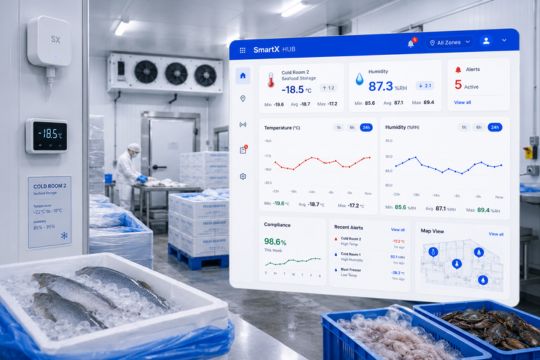
Temperature is the headline metric, but a robust cold chain program watches more than one number. The best systems monitor the conditions and the failure modes that put product at risk — and the health of the monitoring itself.
Temperature
Continuous readings for every fridge, freezer and hot-hold unit, with a safe range set per unit.
Humidity
Critical for produce rooms, dry stores and controlled environments where moisture spoils product.
Door & probe status
A door left ajar or a disconnected probe is caught before it becomes a silent gap in coverage.
Device health
Low-battery and connectivity alerts keep the monitoring reliable, so you never miss a reading.
HACCP and the standards that apply
In food operations, monitoring and compliance are inseparable. HACCP (Hazard Analysis and Critical Control Points) is the framework most food safety programs are built on, and temperature is one of its most common critical control points. Automated monitoring supports it directly: every reading becomes a tamper-evident, time-stamped record, and any excursion at a control point raises both an alert and an audit entry in the same moment. Standards such as ISO 22000 build on the same principles for food safety management.
The practical payoff: when an inspector asks for your temperature history, it is ready on demand — no binders, no gaps, no guesswork. Automation removes the manual documentation and the human error that comes with it.
SmartX HUB delivers cold chain monitoring on one unified platform. Wireless BLE and LoRa sensors track temperature and humidity around the clock, automatic logging handles HACCP records, and cascading thresholds keep alerts precise. Because monitoring shares a platform with maintenance, a failing compressor becomes a work order — not just an alert. Explore the environmental monitoring solution to see it in action.
Cold chain monitoring, topic by topic
This guide is the starting point. These focused reads go deeper on the questions food operators ask most:
HACCP Temperature Monitoring
How automated temperature logging supports your critical control points and keeps you audit-ready.
Restaurant Temperature Monitoring
Why multi-unit restaurants and QSR brands are replacing manual fridge checks with sensors.
Cold Storage Monitoring
Continuous monitoring for walk-in freezers, cold rooms and large storage facilities.
Cold Chain ROI Calculator
Estimate your annual savings from preventing spoilage, cutting manual checks and avoiding fines.
See cold chain monitoring on your own refrigeration
Book a demo and see how SmartX HUB prevents spoilage, ends manual temperature logs, and keeps your food operation inspection-ready.
More Related Topics
Explore our blog for insightful articles, personal reflections and ideas that inspire action on the topics you care about.


L’ORÉAL — Warehouse Quality & Environmental Monitoring
Customer Case · Warehouse Quality & Environmental Monitoring How L'Oréal... read more