
When Every Second Counts: The Critical Challenge of Emergency Accountability
Imagine this scenario: A fire alarm sounds at your manufacturing facility. Hundreds of workers from multiple shifts, contractors, and visitors begin evacuating through various exits. Your emergency coordinator stands at the muster point with a clipboard, trying to account for everyone while chaos unfolds around them.
Questions flood in:
- “Is everyone out of the building?”
- “Who was working in the affected area?”
- “Are we missing anyone?”
- “Can we tell emergency responders if anyone is still inside?”
In traditional emergency roll call systems, answering these questions takes 15 to 45 minutes—time that trapped or injured workers don’t have. Every minute spent manually checking names against lists, radioing supervisors, and searching for missing personnel is a minute when someone’s life might hang in the balance.
This is the fundamental problem with conventional mustering approaches: they were designed for an era when facilities were smaller, workforces were more stable, and the pace of operations was slower. They cannot keep up with modern industrial operations where hundreds of people—employees, contractors, visitors, delivery drivers—move through facilities constantly.
The consequences of slow or inaccurate emergency roll call extend beyond safety:
Life Safety Risk: Delayed identification of missing personnel means delayed rescue efforts and potentially catastrophic outcomes.
Resource Misallocation: Emergency responders may search areas already evacuated while people who are missing remain in actual danger zones.
Operational Chaos: Without clear accountability, evacuation procedures break down, creating additional hazards.
Regulatory Non-Compliance: OSHA and other agencies require effective emergency action plans with demonstrated accountability systems.
Legal Liability: In the aftermath of serious incidents, the inability to account for personnel becomes evidence of inadequate safety management.
The solution exists today: connected worker technology that provides instant, accurate emergency roll call—transforming a process that took 30 minutes into one that takes 30 seconds.
The Fatal Flaws of Traditional Emergency Roll Call
Before exploring how technology solves the emergency mustering challenge, it’s essential to understand why traditional approaches fail under pressure:
1. Dependency on Manual Processes
Traditional mustering relies on supervisors manually checking workers against lists:
- Paper rosters become outdated the moment someone leaves or arrives
- Supervisors may not know all workers by sight, especially contractors
- In multi-shift operations, supervisors may not know who’s actually on site
- During evacuations, supervisors themselves may be unavailable or injured
2. Time-Consuming Verification
Manual roll call inherently takes time:
- Calling out names and waiting for responses
- Cross-referencing multiple lists (employees, contractors, visitors)
- Trying to locate supervisors who can confirm their team’s status
- Radioing or calling departments to verify headcounts
- Re-checking when counts don’t match expectations
3. Accuracy Problems Under Stress
Emergencies amplify human error:
- Workers may answer for absent colleagues
- Confusion about who was actually on site versus who was scheduled
- Visitors or contractors were overlooked in the chaos
- People counted twice as they moved between muster points
- Language barriers are preventing accurate communication
4. Lack of Location Intelligence
Traditional systems can’t answer critical questions:
- Where was the missing person last seen?
- Which areas of the facility have been cleared?
- Are people at the correct muster point for their location?
- Did anyone fail to evacuate completely?
5. Poor Documentation
Post-incident investigations require evidence:
- Manual records are incomplete or contradictory
- Timing is estimated rather than precise
- No objective record of who was where when
- Inability to reconstruct events accurately
How SmartX Safety Transforms Emergency Roll Call
SmartX Safety’s connected worker platform replaces manual, error-prone emergency mustering with automated, real-time accountability that works in seconds.
Instant Headcount at the Touch of a Button
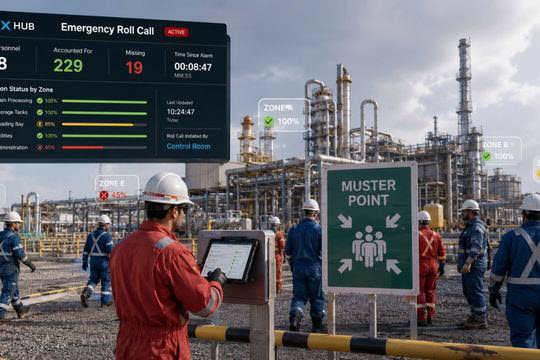
When an emergency occurs, safety coordinators activate the emergency mustering function on the SmartX dashboard. Within seconds, the system:
Identifies All Personnel On-Site: The system instantly shows how many people are currently in the facility, including employees, contractors, and visitors wearing Smart Badges.
Shows Real-Time Locations: A live map displays where every person is at that exact moment—still inside the facility, in evacuation routes, or at designated muster points.
Identifies Missing Personnel: Anyone who hasn’t reached a muster point is immediately flagged, with their last known location highlighted.
Provides Accurate Counts: No guessing, no manual tallying—the system shows exact numbers: “147 people on site. 142 at muster points. 5 unaccounted for.”
Updates Continuously: As people move, the system updates in real-time, showing evacuation progress and confirming when everyone has reached safety.
This transformation from 30-minute manual processes to 30-second automated accountability is not incremental improvement—it’s a fundamental paradigm shift in emergency response capability.
Multi-Zone Mustering for Complex Facilities
Extensive facilities may have multiple muster points based on:
- Building zones (Building A vs. Building B)
- Outdoor vs. indoor locations
- Primary and secondary assembly areas
- Weather shelters for extreme conditions
- Upwind vs. downwind locations for chemical releases
SmartX Safety handles this complexity elegantly:
Automatic Zone Assignment: Workers are directed to the appropriate muster point based on their location when the alarm sounds—those in the north building to the north muster point, and south building workers to the south muster point.
Dynamic Reassignment: If primary muster points are compromised (fire spreading, hazmat cloud drifting), coordinators can instantly reassign people to alternate locations and track compliance.
Multiple Simultaneous Counts: Monitor all muster points simultaneously on a single dashboard—no need to radio between locations or wait for reports.
Stragglers Identification: See who’s still en route and approximately how long until arrival based on current location and speed.
Integration with Building Management Systems
SmartX Safety integrates with existing facility infrastructure to create a comprehensive emergency response:
Fire Alarm Systems: Emergency mustering can automatically activate when fire alarms trigger, initiating the accountability process immediately.
Access Control Systems: Coordinate badge entry/exit data with real-time location tracking to verify who should be on site during emergencies.
Public Address Systems: Send automated announcements to specific zones directing evacuation routes based on the incident location.
Emergency Lighting: Coordinate with emergency lighting to guide people toward appropriate exits based on their current position.
HVAC/Ventilation: In chemical release scenarios, coordinate with building automation to create safe evacuation corridors.
Real-World Applications Across Industries
Manufacturing Facilities
Challenge: Multi-building campuses with 500+ workers across three shifts, plus contractors during maintenance periods.
SmartX Solution:
- Real-time tracking across the entire campus
- Separate muster points for each building
- Contractor integration without separate sign-in processes
- Weather-dependent shelter-in-place vs. evacuation protocols
- Shift handover coordination, ensuring accurate counts during transitions
Results: Emergency mustering time reduced from 35 minutes to under 2 minutes. Missing person identification is instantaneous rather than discovered during re-check procedures.
Construction Sites
Challenge: Changing layouts, temporary structures, workers spread across multiple zones, and frequent contractor rotation.
SmartX Solution:
- Mobile muster points that adjust as site layout changes
- Automated contractor tracking without manual check-in
- Zone-based evacuation ensures workers exit through safe routes
- Integration with daily safety briefings and site access procedures
- Visitor management for inspectors, suppliers, and clients
Results: Demonstrated compliance with OSHA emergency action plan requirements. Ability to account for all personnel during severe weather evacuations in under 90 seconds.
Oil & Gas Facilities
Challenge: Offshore platforms with limited escape routes, refineries with process unit complexity, and remote wellhead operations.
SmartX Solution:
- Lifeboat station mustering with exact personnel counts
- Integration with platform safety systems
- Lone worker accountability for remote operators
- Hazardous area considerations for explosive atmospheres
- Helideck coordination during medical evacuations
Results: Complete platform accountability in under 60 seconds. Regulatory compliance documentation for safety management systems. Integration with emergency shutdown procedures.
Mining Operations
Challenge: Underground workers beyond line of sight, vast open pit areas, remote locations, and communication limitations.
SmartX Solution:
- Underground location tracking throughout tunnel networks
- Surface and underground mustering coordination
- Refuge chamber accountability when evacuation is impossible
- Integration with mine communication infrastructure
- Blast zone clearance verification
Results: Underground emergency evacuation tracking showing real-time movement toward exits and refuge chambers. Post-incident reconstruction capability for investigations.
Warehouses and Distribution Centers
Challenge: High worker density in loading areas, forklift traffic during evacuations, multiple tenant facilities, 24/7 operations.
SmartX Solution:
- Dock area clearance verification
- Equipment operator accountability
- Third-party driver integration
- Multiple tenant separation at shared muster points
- Integration with automated material handling systems
Results: Loading dock areas cleared and verified in under 3 minutes. Forklift operators confirmed that they were safely evacuated before emergency vehicle access.
Office Buildings and Corporate Campuses
Challenge: Employees on different floors, visitors in meetings, contractors performing maintenance, the cafeteria, and common areas.
SmartX Solution:
- Floor-by-floor evacuation tracking
- Visitor badge integration
- Conference room and common area monitoring
- Mobility-impaired personnel identification for evacuation assistance
- Multi-building campus coordination
Results: Complete building accountability in under 5 minutes for an 800-person facility—visitor evacuation verification without manual sign-in sheets.
Beyond Emergency Mustering: Drill Management and Continuous Improvement
SmartX Safety provides value beyond actual emergencies through sophisticated drill management and performance analytics:
Emergency Drill Optimization
Automated Drill Initiation: Schedule and execute emergency drills with system-generated alarms and mustering activation.
Performance Measurement: Track exact evacuation times from alarm to completion to ensure accountability, identify bottlenecks, and pinpoint slow evacuation zones.
Individual Compliance: Identify workers who consistently arrive late to muster points or fail to follow evacuation procedures.
Route Analysis: Understand which evacuation routes workers actually use versus planned routes, revealing potential improvements.
Comparative Analytics: Compare drill performance across shifts, days, and conditions to identify patterns and opportunities for improvement.
Documentation and Compliance
Automatic Records: Complete documentation of every drill and actual emergency—who participated, timing, locations, and issues.
Regulatory Reporting: Generate required documentation for OSHA, insurance audits, and facility certifications.
Trend Analysis: Long-term tracking showing whether emergency response effectiveness improves over time.
Training Integration: Identify workers needing additional emergency procedure training based on drill performance.
Critical Features for Effective Emergency Roll Call Systems
Reliability When It Matters Most
Emergency systems must work during the worst possible conditions:
Power Independence: Smart Badges operate on batteries, continuing to function during power outages.
Network Resilience: LoRaWAN infrastructure maintains connectivity when Wi-Fi and cellular networks fail.
Redundant Gateways: Multiple overlapping coverage ensures no single point of failure.
Offline Capability: Core mustering functions work even if cloud connectivity is lost.
Rugged Design: Equipment survives fires, explosions, and extreme weather that might trigger evacuations.
Speed and Accuracy
The system must deliver actionable information immediately:
Sub-Minute Response: Complete accountability within 60 seconds of activation.
Real-Time Updates: Live data showing evacuation progress, not periodic snapshots.
Precise Location: Down to room/zone level, not just “somewhere in building.”
Confidence Metrics: System reliability indicators showing data quality and coverage.
Ease of Use Under Stress
Emergency coordinators may be under extreme pressure:
Intuitive Interface: One-button mustering activation, clear visual status.
Color-Coded Alerts: Immediate visual indication of issues requiring attention.
Automated Notifications: System alerts key personnel without manual calling.
Mobile Access: Emergency coordinators can access data from smartphones if evacuated from control rooms.
Scalability Across Facilities
Systems must adapt to different scenarios:
Flexible Muster Points: Easy configuration of primary, secondary, and shelter-in-place locations.
Customizable Zones: Define evacuation areas that match the facility layout and hazards.
Variable Populations: Handle daily workforce, shutdown maintenance crews, or minimum staffing equally well.
Multi-Site Management: Corporate safety directors oversee multiple facilities from a single dashboard.
Implementation: Making Emergency Roll Call Actually Work
Integration with Emergency Action Plans
SmartX Safety enhances rather than replaces your emergency procedures:
EAP Alignment: Configure muster points, evacuation routes, and procedures to match existing emergency action plans.
Tabletop Exercises: Use the system during planning sessions to identify gaps and optimize procedures.
Incremental Deployment: Start with the highest-priority buildings or areas, expand based on results.
Procedure Documentation: Update emergency procedures to reflect technology capabilities while maintaining manual backup procedures.
Training and Change Management
Technology succeeds only when people use it correctly:
Worker Education: Explain how badges work during emergencies and why accountability matters.
Coordinator Training: Ensure emergency coordinators understand system capabilities and limitations.
Regular Drills: Practice using the system during routine drills so procedures are automatic during actual emergencies.
Continuous Improvement: Review drill data with teams to identify and address performance gaps.
Testing and Validation
Prove the system works before you need it:
Coverage Verification: Confirm reliable badge tracking throughout all evacuation routes and muster points.
Worst-Case Scenarios: Test during shift changes, bad weather, and other challenging conditions.
Failure Mode Testing: Verify backup procedures if primary systems fail.
Third-Party Validation: Have fire marshals or safety consultants evaluate system effectiveness.
The ROI of Instant Emergency Accountability
Direct Safety Benefits
Faster Rescue: Missing persons are identified within seconds, enabling immediate search-and-rescue deployment.
Better Resource Allocation: Emergency responders know exactly where to focus efforts.
Reduced Panic: Clear, rapid accountability reduces chaos and secondary incidents.
Improved Outcomes: Minutes saved during emergencies translate directly to lives saved.
Operational Benefits
Reduced Downtime: Faster all-clear means quicker return to operations after false alarms.
Better Drills: Data-driven improvement of emergency procedures and training.
Multi-Use Platform: Same infrastructure supports daily safety monitoring, not just emergencies.
Scalable Solution: One system handles routine attendance through catastrophic incidents.
Compliance and Liability
Regulatory Confidence: Demonstrate sophisticated emergency management to inspectors.
Documentation: Complete, objective records of emergency response effectiveness.
Litigation Defense: Prove due diligence in protecting workers during incidents.
Insurance Benefits: Potential premium reductions for demonstrated risk management.
The Future: Predictive Emergency Response
As connected worker systems mature, they’re evolving beyond reactive accountability toward predictive capabilities:
AI Pattern Recognition: Identify unusual movement patterns that might indicate unfolding emergencies before alarms sound.
Automated Response: System-initiated evacuations when sensors detect conditions exceeding thresholds.
Optimized Routing: Real-time guidance directing workers away from hazards toward the safest exits.
Capacity Management: Prevent overcrowding at muster points by balancing populations across multiple locations.
Integration with First Responders: Direct data feeds to arriving emergency services showing facility layout, personnel locations, and hazard information.
But these future capabilities build on the foundation of reliable, proven emergency mustering systems deployed today.