Customer Case · Asset Management with RFID

How Fundação Zerrenner Achieved 40% More Efficient Asset Management with RFID

A century-old Brazilian foundation brought modern visibility to its most valuable assets — from artwork to IT equipment — protecting decades of social investment with RFID tracking.

Brazil Non-Profit · Founded 1936 40% more efficient
Introduction

The customer: Fundação Zerrenner

Fundação Zerrenner is a renowned Brazilian non-profit organization, founded in 1936, dedicated to promoting social welfare through education, health and culture initiatives. Over the past decade, the foundation has invested more than $20 million in community projects.

Protecting and managing these investments — from artwork to IT equipment — required a modern asset tracking solution.

The Challenge

High-value assets, no real-time visibility

The foundation struggled to locate assets distributed across multiple offices. High-value items such as artwork and IT equipment frequently went untracked, leading to losses and improper allocations. Traditional inventory management depended on manual data entry — resulting in errors, inefficiencies and a lack of real-time visibility.

Hard to locate

Assets spread across multiple offices were difficult to find.

Untracked high-value items

Artwork and IT equipment often went untracked entirely.

Manual data entry

Traditional inventory relied on manual entry, causing errors.

Losses & misallocation

Poor visibility led to losses and improper asset allocations.

Beyond the inventory

A Sweep Tells You a Painting Is Gone. It Doesn't Tell You While It Is Going.

Portable readers solved the counting problem, and counting was the larger one. But a periodic inventory has a blind spot that matters more for artwork than for a laptop: it discovers a loss at the next sweep, which may be weeks after the loss happened.

For pieces that are irreplaceable rather than merely expensive, the useful moment is earlier. So the highest-value works were given a second layer: a BLE beacon, watched continuously by gateways, that raises an alarm the moment the piece moves.

A beacon on the frame, gateways on the wall
The beacon is fixed to the piece and reports its own motion state. Gateways in the room listen continuously — there is no scan, no operator and no schedule. The piece is either at rest or it is not.
A threshold per piece, not per building
Sensitivity is configured for each asset individually. A canvas on a partition wall in a corridor and a sculpture on a plinth do not tolerate the same amount of ordinary vibration — one setting for both would mean either false alarms or missed events.
Four states, not two
Alarm
Movement at or beyond the configured threshold, or a tamper flag from the beacon itself.
Moving
Motion detected, below the alarm threshold. Someone is working nearby, or a door slammed.
OK
At rest, reporting normally. The state the piece should be in almost always.
Offline
The beacon has stopped reporting. Not the same as OK — and that distinction is the point.

The fourth state is the one that separates a usable system from a decorative one. A beacon that went quiet is not a piece that is safe — a battery ran out, or something interfered, or someone removed the tag. Treating silence as "fine" is how monitoring systems fail without anyone noticing.

What security receives

The alarm arrives through the same notification channels as every other alert on the platform — the same escalation rules, the same acknowledgment, the same cooldown. It is not a separate console that someone has to remember to watch.

And the acknowledgment log records who responded and when. For a foundation holding pieces in trust, that record is not a convenience — it is the evidence that the custody obligation was met.

The two layers answer different questions. The portable reader answers "is everything where the register says it is?" — periodically, across the whole estate. The beacon answers "is this piece moving right now?" — continuously, for the few dozen items where the answer cannot wait. See asset loss prevention.

The Solution

RFID with portable readers

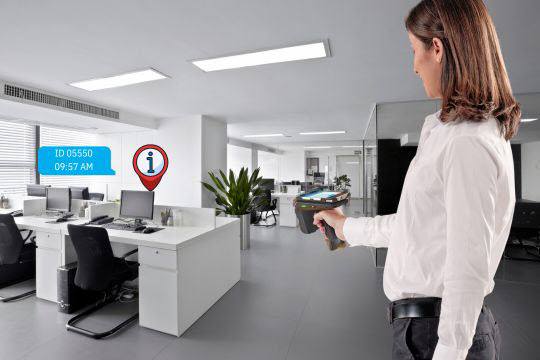
SmartX HUB's asset-visibility solution was implemented using RFID technology with portable readers — simple to roll out across offices, powerful enough to track everything from a painting to a laptop.

RFID Tagging

Every asset receives a unique RFID identifier for instant, automated tracking.

Portable RFID Readers

Fast, accurate inventory operations with batch-processing capabilities.

SmartX HUB Platform

A centralized dashboard for real-time asset location and status monitoring.

Batch reading is the efficiency multiplier

A portable RFID reader captures dozens of tags in a single sweep, so a full-room inventory takes moments instead of an afternoon. That batch-processing capability is what turned a manual, error-prone routine into asset management that's 40% more efficient — while keeping irreplaceable artwork accounted for.

Implementation & Results

Measurable, transformative results

40%
more efficient management
Real-time
asset visibility
Batch
RFID reading
  • Full transparency in asset location and status, significantly reducing losses.
  • 40% more efficient asset management with batch processing and RFID reading.
  • Optimized workflows, minimizing errors in asset tracking and allocation.
Conclusion

Protecting what matters, at any scale

SmartX HUB and RFID delivered total visibility and 40% more efficient management for Fundação Zerrenner's assets. Whether you're managing artwork, IT equipment or any high-value items across multiple locations, RFID-powered tracking provides the accuracy and speed that manual methods simply cannot match.

Explore related capabilities: Asset Inventory Management, Real-Time Asset Tracking, and Loss Prevention.

Protect your high-value assets with total visibility

See how SmartX HUB uses RFID and portable readers to track everything from artwork to IT equipment — accurately and efficiently, across every location.

More Related Topics

Explore our blog for insightful articles, personal reflections and ideas that inspire action on the topics you care about.